technologybriefs
9:31in productionCh. 1 · What it was/ 9:31 · ceiling 15 min
Semiconductors

Maxim Integrated

1983

Maxim didn’t invent analog — it weaponised compatibility.

Maxim Integrated was a pragmatic analog IC company that prioritised compatibility, speed-to-market, and application-specific integration over architectural novelty. Its success came from solving narrow, persistent interface problems — not from inventing new physics or scaling digital logic.

Chapters & takeaways4
  1. 0:58
    What it was

    Maxim was an analog and mixed-signal IC company — not digital, not software, not systems.

  2. 2:19
    The clone-first model

    It started by cloning other people’s chips — 24 second-source parts in year one.

  3. 3:33
    The chip that funded everything

    The MAX232 paid the bills — Maxim’s first profit came from one chip that solved a universal wiring problem.

  4. 5:42
    The wafer milestone

    Its 2010 300mm analog shipment was a late-stage manufacturing upgrade — not a new capability.

Worth your time?

Yes. Study the whole thing.

3.5/ 5
What works
  • second-source strategy
  • MAX232 as revenue engine
  • mixed-signal integration for real-world interfaces
What does not
  • pioneer new process nodes
  • achieve scale in digital logic
  • drive foundational analog research
Study it if
  • analog circuit designers
  • industrial hardware maintainers
  • legacy-system integrators
Skip it if
  • AI accelerator architects
  • cloud infrastructure engineers
  • software-defined radio developers
The written brief1 min read

What it is and the problem it solves

Maxim Integrated was a semiconductor company solving the problem of interoperability and reliability in analog signal chains — especially where RS-232 communication, voltage regulation, and sensor interfacing demanded robust, pin-compatible parts.

How it works

Maxim Integrated designed, manufactured, and sold analog and mixed-signal integrated circuits. It built its early business on second-source products — drop-in replacements for existing ICs — and launched proprietary chips like the MAX600 and MAX232.

What works

Its second-source strategy worked immediately: 24 products in year one. The MAX232 worked well enough to drive profitability in 1987. Its focus on mixed-signal integration — combining analog functions with basic digital logic — solved real interface problems in industrial and computing gear.

What does not

Maxim did not pioneer new semiconductor process nodes or architecture paradigms. It did not achieve scale in digital logic, microprocessors, or memory. Its 300mm wafer shipment in 2010 was a manufacturing milestone, not a design innovation.

What it changes

It changed how analog ICs reached market: by prioritising compatibility, rapid time-to-volume, and application-specific integration over foundational research. It proved analog could be commercialised as a vertical stack — design, fab-lite manufacturing, and direct sales — rather than as a foundry service.

Is it worth your time

Yes — if you work with analog interfaces, legacy industrial or communications hardware, or discrete signal conditioning. Its product lineage remains embedded in real-world systems, but its relevance to new designs has declined since its 2019 acquisition by Analog Devices.
Same field · Semiconductors4 of 12
10:06
Analog Devices1965Analog Devices is not a general-purpose chipmaker. It is a precision signal interface company. Its value lies in making ADCs and DACs that preserve fidelity across temperature, time, and voltage — not in speed, scale, or software. Its inventions shrink the gap between physical reality and digital representation — but only where that gap matters most.
9:49
Applied Materials1967Applied Materials (1967) is not an invention. It is a corporation. Its significance lies in system integration and strategic acquisition — not a singular breakthrough. The Precision 5000 redefined semiconductor tool architecture. SunFab scaled thin-film solar. HCT and Baccini filled capability gaps. None of this originates in 1967 per the sources. The year is irrelevant to the documented innovations.
10:26
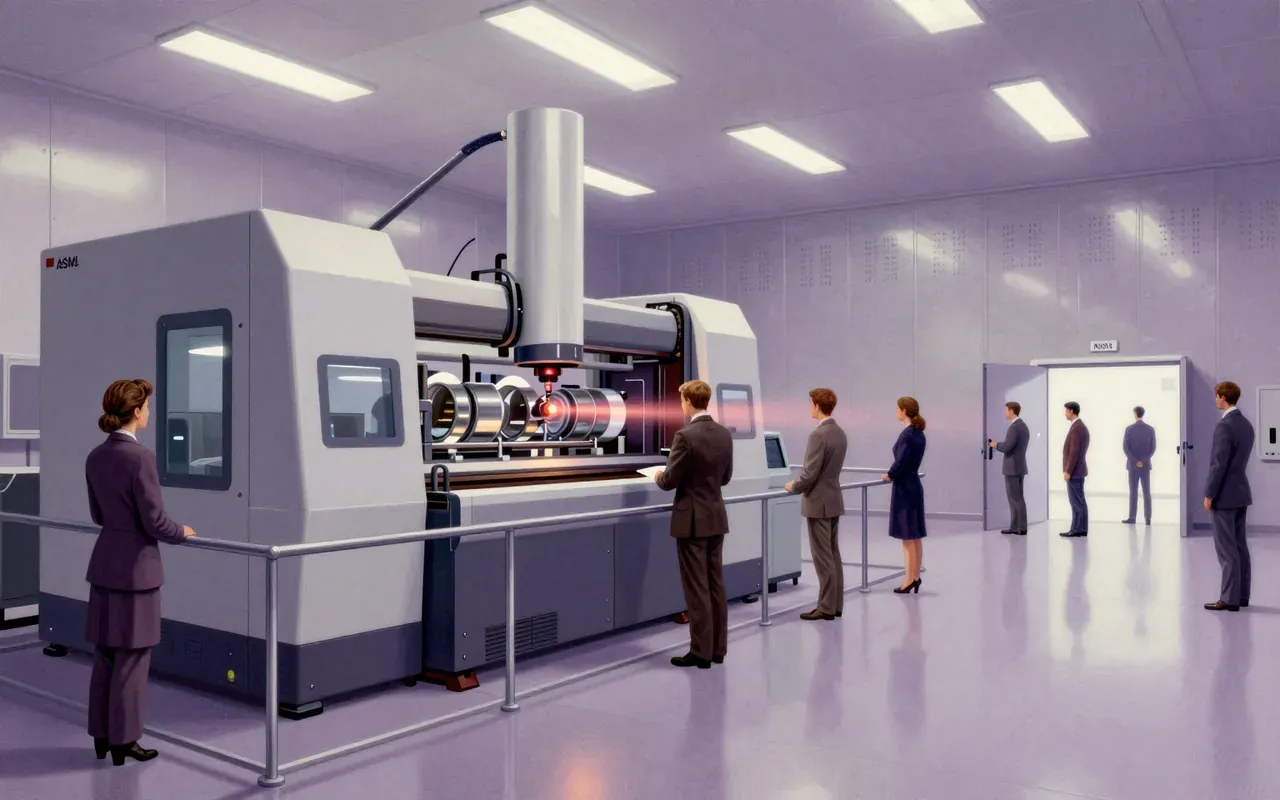
ASML1984ASML is the dominant supplier of photolithography machines for integrated circuit production. Founded in 1984 as a joint venture between Philips and ASM International, it inherited Philips’ stalled lithography project and initially had no market-ready product. Its first machine, the PAS 2000, failed commercially and technically. Success came with the PAS 5500 in the early 1990s. By 2002, ASML was the largest lithography supplier. It now leads in extreme ultraviolet (EUV) lithography—the only viable method for manufacturing the most advanced chips—and completed EUV machine development in the late 2010s. Competitors included Canon, Nikon, Ultratech, MKS Instruments, Lam Research, and Cadence Design Systems.
10:20
Carver MeadMead established semiconductor design as a discipline rooted in quantum transport physics — not process empiricism. His verified contributions span device invention (tunnel transistor, GaAs MESFET), nanoscale electron dynamics (hot-electron retention), scaling theory (multi-dimensional improvement to 0.15 µm), and pedagogy (first LSI course, VLSI textbook, shared-wafer fabrication). He did not foresee CMOS, interconnect bottlenecks, or post-Moore architectures. His framework remains indispensable for anyone modelling devices below 100 nm — but stops where quantum coherence and statistical variation begin.
Up next in Technology

Nintendo Switch

2017 · 9:27

A console that doesn’t choose between TV and pocket—it just demands you carry both contexts at once.

9:27