What it is and the problem it solves
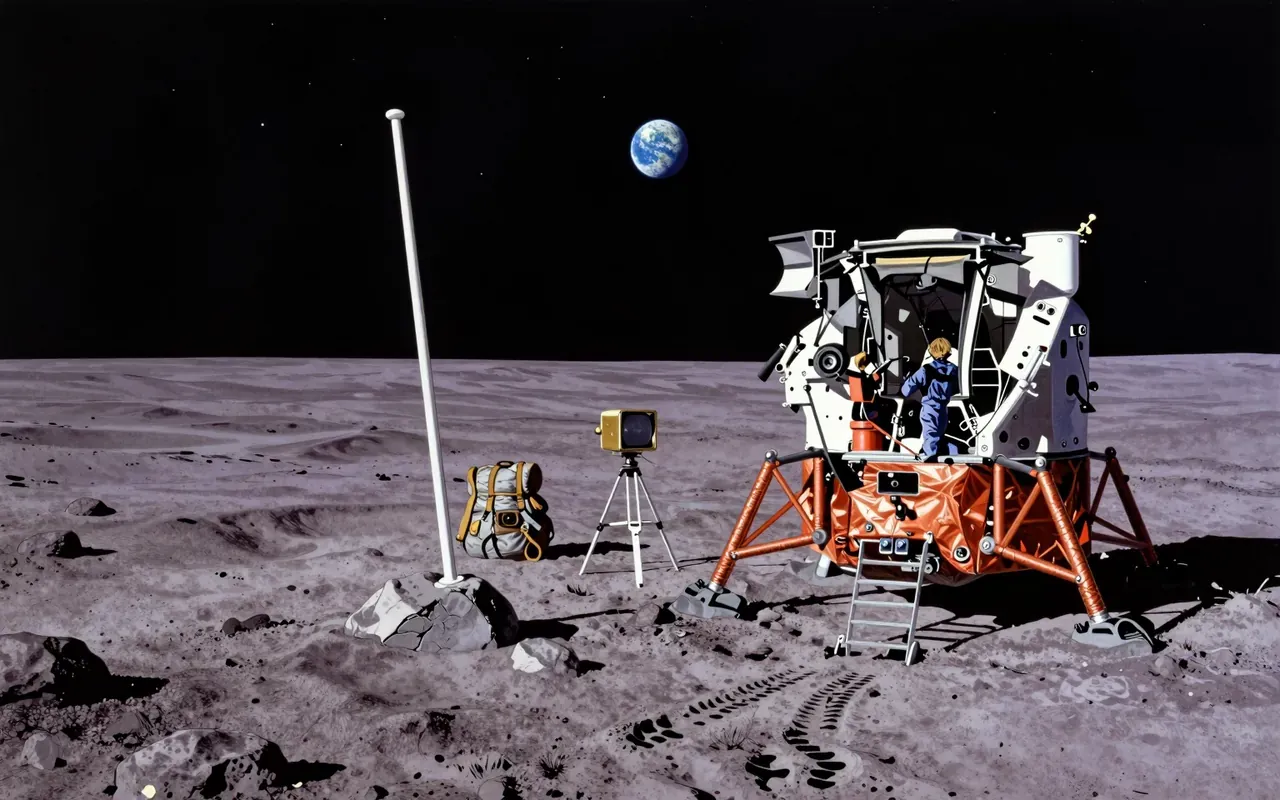
Apollo was a U.S. human spaceflight programme conceived in 1960 and run from 1961 to 1972. It solved the political problem of demonstrating technological supremacy during the Cold War by achieving Kennedy’s 1961 goal: landing humans on the Moon and returning them safely before 1970.
How it works
Apollo used the Saturn family of rockets to launch spacecraft beyond low Earth orbit. It relied on three-module architecture: command, service, and lunar modules. Crewed flights began in 1968. Missions followed a sequence: Earth orbit, translunar injection, lunar orbit, descent, surface operations, ascent, rendezvous, trans-Earth injection, and ocean splashdown.
What works
Six crewed lunar landings occurred between 1969 and 1972. Twelve people walked on the Moon. Apollo 8 broke Earth orbit in 1968—the first crewed departure from low Earth orbit. Apollo 11 achieved the first crewed lunar landing on 20 July 1969. The programme returned 382 kg of lunar material, advancing lunar geology.
What does not
Apollo did not establish sustained lunar presence. It did not enable reusable launch systems. It did not lower the cost of access to space. It did not lead directly to follow-on crewed lunar missions. It ended in 1972 with no immediate successor.
What it changes
Apollo changed the scope of what was considered feasible for human spaceflight. It proved that complex, distributed engineering systems could be integrated across thousands of contractors and agencies under fixed deadlines. It shifted planetary science from remote observation to direct sample return. It redefined national technical ambition as a geopolitical instrument.
Is it worth your time
Yes—if you work in systems engineering, mission-critical software, or large-scale project coordination. Apollo remains the only human programme to land people on another celestial body. Its constraints, trade-offs, and failure containment mechanisms are still instructive. Its scale and timeline are not replicable today without equivalent political will and budget priority.