10:28in productionCh. 1 · First and only/ 10:28 · ceiling 15 min
Systems
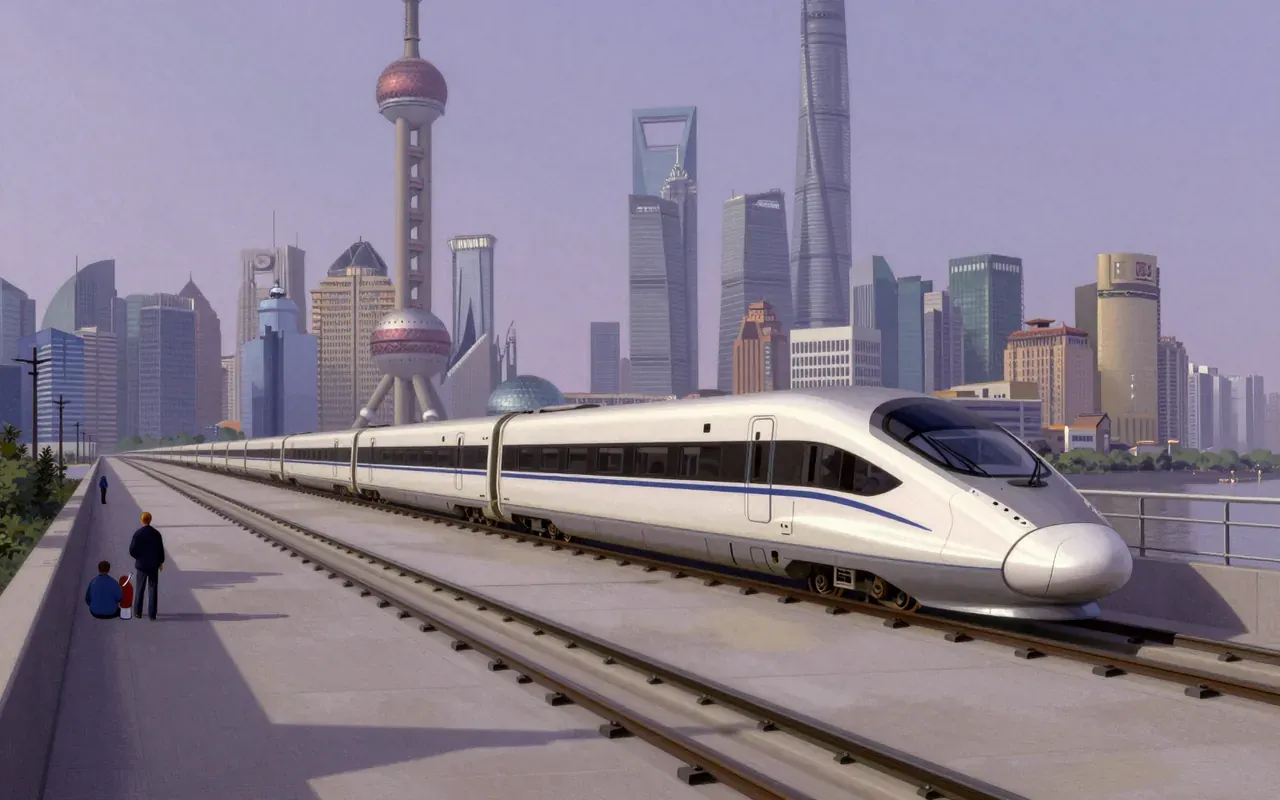
Shanghai maglev train
The Shanghai maglev proves maglev works — and why no one else built one.
The Shanghai maglev is a functional, isolated demonstration: fast, precise, and expensive. It solved one narrow problem — airport access — with unmatched speed, but revealed maglev’s limits in cost, integration, and adaptability. Its legacy is not expansion, but constraint.
It was the world’s first commercial high-speed maglev — and remains the only one operating at scale.
2:34
Speed cut
It held the title of world’s fastest commercial train for 17 years — then halved its top speed.
4:22
Eight minutes, ten seconds
It covers 30 km in under 9 minutes — but only because it starts and stops in isolation.
6:09
One column every 25 metres
Alluvial soil forced engineers to double the number of support columns — a hidden cost of terrain adaptation.
Worth your time?
Yes. Study the whole thing.
3.5/ 5
What works
achieves 300 km/h in 2m15s
completes 30 km in 8m10s
operates reliably on alluvial soil with modified column spacing
What does not
scale
integrate
reduce total door-to-door time for most users
Study it if
transport engineers assessing maglev viability in soft soils
urban planners evaluating dedicated airport links
Skip it if
policy makers seeking mass-transit models
investors expecting replication
The written brief1 min read
What it is and the problem it solves
It is a 30 km dedicated maglev line connecting Longyang Road station to Pudong Airport. It solves the problem of slow surface transport between central Shanghai and the airport — but only for passengers who can access Longyang Road.
How it works
It uses magnetic levitation to suspend, guide, and propel trains without physical contact with the track. Electromagnets on the train and guideway create repulsive and attractive forces that lift the train 10 mm above the track and accelerate it linearly.
What works
It reliably completes the 30 km journey in 8 minutes and 10 seconds. It accelerates to 300 km/h in 2 minutes and 15 seconds. It sustained 431 km/h in commercial operation from April 2004 until May 2021.
What does not
It does not scale beyond its single line. No extension has been built since 2004. It does not integrate with Shanghai’s metro network. It does not reduce journey time for most travellers, who must still reach Longyang Road station by other means.
What it changes
It establishes that commercial high-speed maglev is technically viable in alluvial soil — but only by doubling support column density to one every 25 metres, increasing construction cost and complexity.
Is it worth your time
Only if you are evaluating maglev as a high-cost, low-coverage urban airport link with proven speed but unproven scalability. It delivers time savings on one 30 km corridor — nothing more.