technologybriefs
10:06in productionCh. 1 · The Founding Bet/ 10:06 · ceiling 15 min
Semiconductors

Analog Devices

1965

Precision signal conversion is not magic — it’s Analog Devices’ 1965 bet that the world would need chips that don’t lie about voltage.

Analog Devices is not a general-purpose chipmaker. It is a precision signal interface company. Its value lies in making ADCs and DACs that preserve fidelity across temperature, time, and voltage — not in speed, scale, or software. Its inventions shrink the gap between physical reality and digital representation — but only where that gap matters most.

Chapters & takeaways5
  1. 1:10
    The Founding Bet

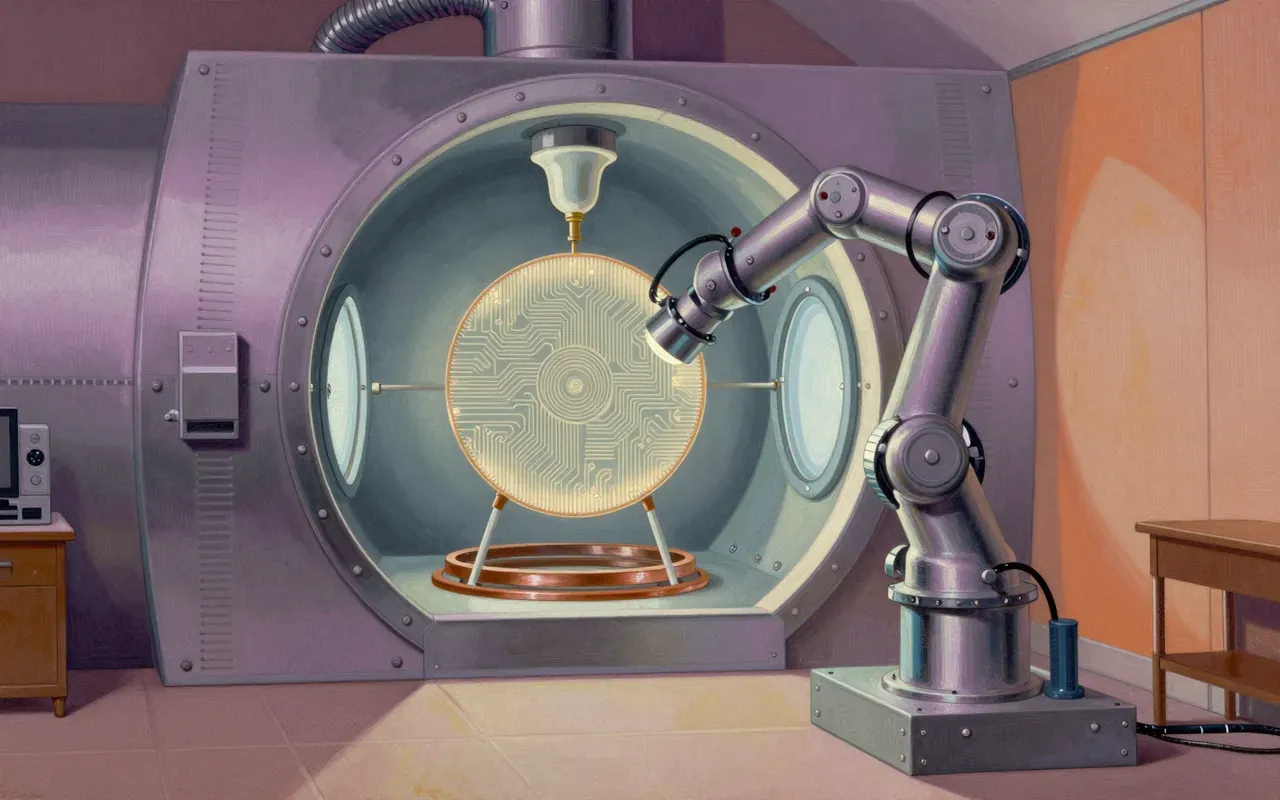
    Founded by two MIT graduates in 1965, Analog Devices began as a focused response to the instability of analog circuit design.

  2. 2:20
    First Product, First Constraint

    Its first product — the Model 101 op amp — was a hockey-puck sized module built for test and measurement, not consumer electronics.

  3. 3:41
    The 1973 Inflection

    In 1973, laser-trimmed wafers and the first CMOS DAC proved analog precision could be mass-produced, not hand-tuned.

  4. 5:00
    What It Actually Converts

    Its chips convert light, sound, temperature, and motion into digital data — and back — wherever accuracy is non-negotiable.

  5. 6:13
    Where It Pays Off

    More than half its revenue comes from data converters — deployed in medical gear, IceCube, and National Instruments systems.

Worth your time?

Yes. Study the whole thing.

4.5/ 5
What works
  • high-precision analog-to-digital conversion
  • low-drift signal conditioning
  • CMOS DAC integration
  • laser-trimmed resistor stability
What does not
  • digital logic
  • microprocessors
  • consumer electronics platforms
  • AI accelerators
Study it if
  • instrumentation engineers
  • medical device designers
  • industrial control architects
Skip it if
  • web developers
  • ML researchers
  • mobile app designers
The written brief2 min read

What it is and the problem it solves

Analog Devices is a semiconductor company founded in 1965 to solve one problem: reliably converting real-world analog signals into digital data without losing critical information. Before it, such conversion required custom-built, unstable, bulky modules. The problem is not digitisation itself — it is precision, repeatability, and integration under real-world conditions.

How it works

Analog Devices builds integrated circuits that convert electrical representations of real-world analog phenomena — light, sound, temperature, motion, pressure — into digital signals and back again. It uses operational amplifiers, data converters (ADCs/DACs), and RFICs. Its 1965 Model 101 op amp was a hockey-puck sized module for test equipment. In 1973, it launched laser-trimmed wafers and the first CMOS digital-to-analog converter.

What works

Its data converters account for more than 50% of its revenue. They are used by National Instruments in high-precision measurement systems. They are embedded in IceCube’s digital optical modules at the South Pole. They enable accurate signal conversion in medical systems, radar, wireless communications, and industrial process control.

What does not

It does not build full-system solutions. It does not define end-user products. It does not compete in digital logic, CPUs, or consumer SoCs. Its technology does not eliminate noise, drift, or quantisation error — it minimises them within defined tolerances at cost.

What it changes

It changes how engineers interface digital systems with physical reality. It enables instruments that measure neutrino interactions at the South Pole, calibrate medical imaging devices, and control industrial processes with sub-millivolt fidelity. It makes analog-to-digital conversion a repeatable, scalable IC function — not a bespoke circuit design task.

Is it worth your time

Yes — if your work depends on high-precision signal conversion in medical systems, scientific instrumentation, industrial control, or communications. No — if you need general-purpose logic, memory, or microprocessors. Its core competence is narrow, deep, and non-substitutable where accuracy matters.

Same field · Semiconductors4 of 12
9:49
Applied Materials1967Applied Materials (1967) is not an invention. It is a corporation. Its significance lies in system integration and strategic acquisition — not a singular breakthrough. The Precision 5000 redefined semiconductor tool architecture. SunFab scaled thin-film solar. HCT and Baccini filled capability gaps. None of this originates in 1967 per the sources. The year is irrelevant to the documented innovations.
10:26
ASML1984ASML is the dominant supplier of photolithography machines for integrated circuit production. Founded in 1984 as a joint venture between Philips and ASM International, it inherited Philips’ stalled lithography project and initially had no market-ready product. Its first machine, the PAS 2000, failed commercially and technically. Success came with the PAS 5500 in the early 1990s. By 2002, ASML was the largest lithography supplier. It now leads in extreme ultraviolet (EUV) lithography—the only viable method for manufacturing the most advanced chips—and completed EUV machine development in the late 2010s. Competitors included Canon, Nikon, Ultratech, MKS Instruments, Lam Research, and Cadence Design Systems.
10:20
Carver MeadMead established semiconductor design as a discipline rooted in quantum transport physics — not process empiricism. His verified contributions span device invention (tunnel transistor, GaAs MESFET), nanoscale electron dynamics (hot-electron retention), scaling theory (multi-dimensional improvement to 0.15 µm), and pedagogy (first LSI course, VLSI textbook, shared-wafer fabrication). He did not foresee CMOS, interconnect bottlenecks, or post-Moore architectures. His framework remains indispensable for anyone modelling devices below 100 nm — but stops where quantum coherence and statistical variation begin.
9:35
Commodore 64The Commodore 64 delivers audiovisual capability through custom silicon—not software or architecture. Its dominance came from cost-engineered integration of the VIC-II and SID chips, not scalability or abstraction. It changed what consumers expected from home computers—but left no direct lineage in modern computing stacks.
Up next in Technology

Andrej Karpathy

· 9:34

Karpathy isn’t an invention—he’s a translator who turns AI into lecture halls and slang.

9:34