technologybriefs
10:21in productionCh. 1 · First to market/ 10:21 · ceiling 15 min
Products · Energy

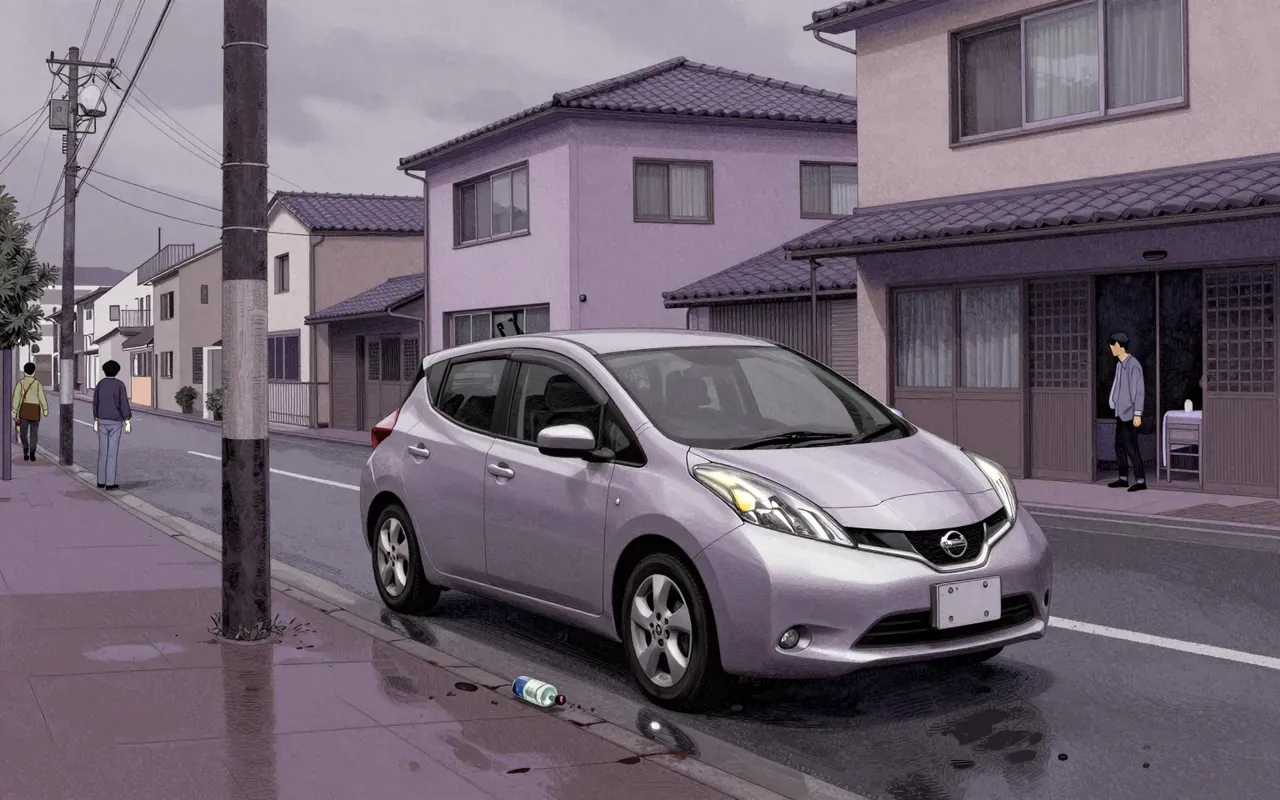
Nissan Leaf

The Leaf didn’t invent the EV — it weaponised the spreadsheet against petrol.

The Nissan Leaf is a battery electric car produced by Nissan since 2010. It was unveiled on 1 August 2009 as the world's first mass-market electric and zero-emission vehicle. Production began on 22 October 2010 at the Oppama facility in Yokosuka, Kanagawa. The first generation used a 192-cell laminated lithium-ion battery pack co-developed with NEC, positioned under the floor between the wheels for optimized handling and space. Its motor delivered 80 kW (110 hp) and enabled ~160 km (100 miles) of range on a full charge. It was offered exclusively as a 5-door hatchback until 2025, when it became a crossover SUV model. By December 2020, cumulative global deliveries reached 500,000 units.

Chapters & takeaways4
  1. 1:12
    First to market

    It was the first mass-market electric vehicle — not the first EV, not the first prototype, but the first built for global sale at scale.

  2. 2:30
    Battery as chassis

    Its battery sits flat under the floor — a deliberate packaging choice that prioritised space and stability over thermal resilience or upgradeability.

  3. 4:20
    Sales dominance

    It dominated pure-EV sales for a decade — not by outperforming rivals, but by arriving first and shipping relentlessly.

  4. 6:25
    Form follows fleet

    It remained a hatchback for 15 years before pivoting to a crossover SUV in 2025 — a late, structural admission that form followed function only until the market demanded otherwise.

Worth your time?

Yes. Study the whole thing.

3.5/ 5
What works
  • Proved global demand for highway-capable EVs
  • Established floor-mounted battery as default layout
  • Achieved 500,000-unit sales milestone by December 2020
What does not
  • Deliver range beyond 160 km on first-gen hardware
  • Support modern DC fast-charging standards natively
  • Decouple battery degradation from ambient temperature
Study it if
  • Historians of industrial electrification
  • Policy analysts assessing early EV subsidy impact
  • Automotive engineers studying packaging trade-offs
Skip it if
  • Fleet buyers evaluating current TCO
  • Consumers comparing 2024–2025 EV options
  • Developers building charging infrastructure
The written brief1 min read

What it is and the problem it solves

The Nissan Leaf is a battery electric car introduced in 2010. It solves the problem of demonstrating that a zero-emission vehicle can be mass-produced, globally distributed, and commercially viable without subsidies alone.

How it works

The first generation Nissan Leaf uses a 192-cell laminated lithium-ion battery pack co-developed with NEC. The pack sits under the floor between the wheels to optimise handling and interior space. Its electric motor delivers 80 kW (110 hp) and enables ~160 km (100 miles) of range on a full charge.

What works

Its floor-mounted battery layout delivers low centre of gravity and usable cabin space. Its production at Oppama from 22 October 2010 enabled rapid global rollout. Its sales milestones — 100,000 by mid-January 2014, 200,000 by December 2015, 500,000 by December 2020 — prove sustained market acceptance.

What does not

It does not scale range without compromising cost or packaging. It does not support fast charging at levels now standard. It does not decouple battery degradation from climate or driving patterns — a flaw exposed within years of deployment.

What it changes

It changes the automotive industry’s timeline for electrification by proving demand exists for a zero-emission, highway-capable car sold globally at volume. It forces competitors to accelerate their own EV roadmaps — not because it outperforms them, but because it sells.

Is it worth your time

It is worth your time only if you need a historical reference point for mass-market EV adoption — not as a benchmark for performance, range, or architecture. Its design choices shaped early consumer expectations, but its technical limits were baked in from launch.

Same field · Products4 of 33
9:59
PalmPilotThe PalmPilot Personal and Professional launched March 10, 1997 as second-generation Palm PDAs—handheld electronic organisers. They offered 512 KB or 1 MB of memory, Palm OS 2.0, and optional 14.4 kbit/s modem support. Upgrade kits enabled Pilot 1000/5000 users to match Professional specs. Prices were $299, $399, and $199 (or $99 for registered users). It worked well for core tasks but lacked scalability, wireless capability, and long-term software evolution.
10:33
WiiNintendo · 2006The Wii is Nintendo’s seventh-generation home video game console, launched in November 2006. It prioritises accessible motion-based interaction over computational power. Its innovation is the Wii Remote—using MEMS accelerometers and infrared sensors for gesture recognition and pointing—supported by the Sensor Bar. It introduced native Internet connectivity (802.11b/g Wi-Fi and Bluetooth), digital distribution via the Wii Shop Channel, and backward compatibility with GameCube software and accessories in early models. It achieved massive commercial success—over 101 million units sold by 2016—by appealing to non-traditional audiences through intuitive controls, low price, and family-friendly software like Wii Sports. Its hardware uses off-the-shelf components, prioritising cost efficiency and energy savings over high-definition graphics or processing power.
11:04
PlayStation VRSony · 2016PlayStation VR is a tethered virtual reality headset developed by Sony Interactive Entertainment and released in October 2016. It requires a PlayStation 4, uses camera-based tracking via nine LEDs, and enforces a minimum 60 fps across all software. It sold at least 5 million units before being succeeded by PlayStation VR2 in 2023.
9:38
Unity (game engine)2005Unity is a real-time 3D development platform first released in June 2005 for Mac OS X. It solves the problem of fragmented tooling by unifying authoring, rendering, physics, animation, and deployment into one editor. It abstracts platform-specific graphics APIs (DirectX, OpenGL, Vulkan) and input systems so the same code runs across Mac OS X, Windows, Linux, mobile, consoles, AR, and VR. Its cross-platform build system works reliably for iOS, Android, Windows, and macOS. Mecanim (introduced in Unity 4.0, November 2012) delivers robust, layered animation state machines. The Scriptable Render Pipeline (evolved from Unity 2018 onward) enables custom rendering paths like URP and HDRP. Unity does not deliver consistent performance across all target platforms without significant tuning. Its visual scripting tools remain secondary to C#. The 2023–2024 runtime fee proposal exposed fragility in its commercial model, even after cancellation. Unity changed who can ship polished interactive 3D software: indie teams, architects, educators, and automotive designers now ship production-grade visuals without building engines from scratch. It shifted real-time 3D development from specialist studios to generalist coders. Yes—if you need rapid iteration on small-to-mid-sized 3D or 2D projects across many platforms, and can absorb subscription licensing and runtime uncertainty. No—if you require full engine control, long-term perpetual licensing, or predictable deployment costs.
Up next in Technology

Nokia 3310

· 9:08

Durability isn’t a feature — it’s the entire product architecture.

9:08