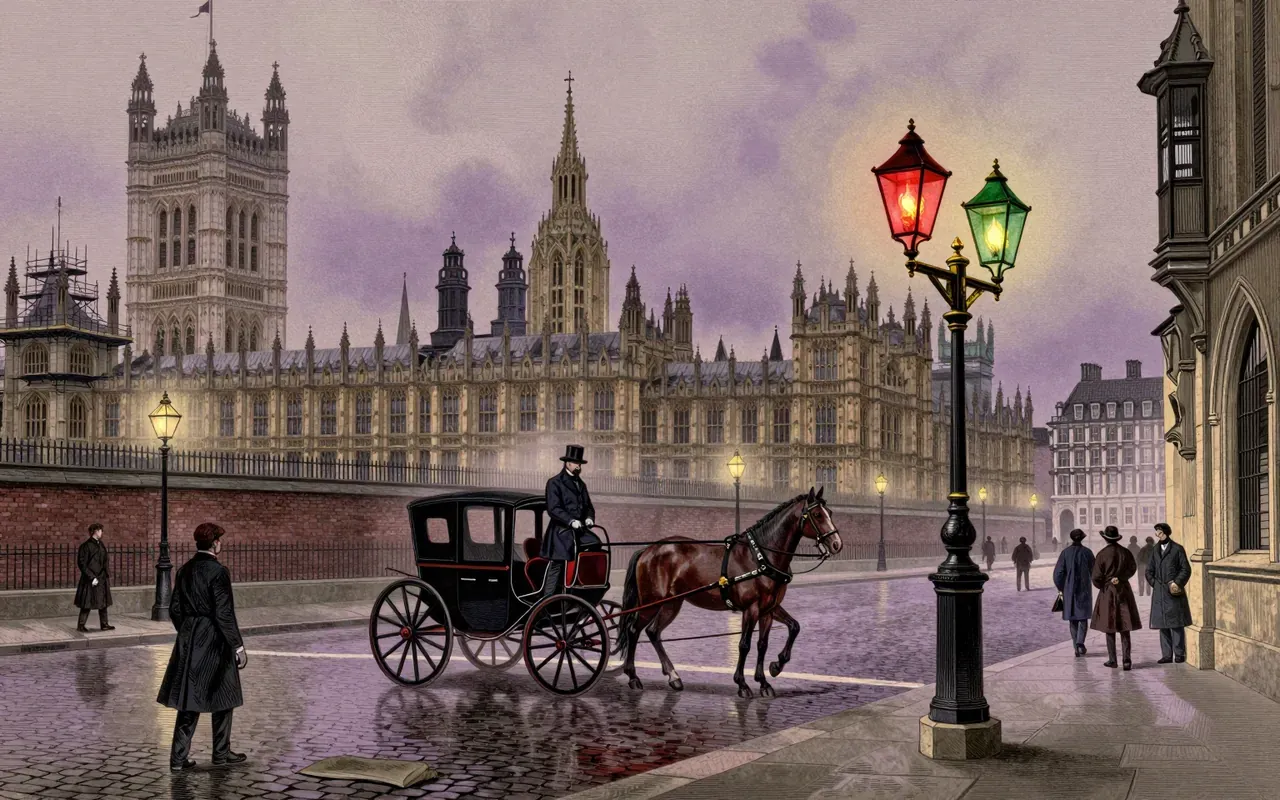
The 1868 traffic light was a short-lived, manually operated, gas-lit semaphore installed on Parliament Square to reduce police workload. It introduced red/green night signalling but exploded within weeks. It established no durable mechanism, no automation, and no safety record. Its legacy is purely symbolic: the first attempt to encode traffic flow in colour and position — not a working system.
It replaced a traffic officer with a single operator controlling a gas-lit semaphore.
2:15
Labour-saving, not life-saving
It was installed specifically to reduce police labour at Parliament Square.
3:48
First night-time colour signals
Red and green lights at night were its novel visual feature — but only for three weeks.
5:09
The real automation came later
Automatic timers — not this invention — delivered the real cost saving, starting in 1922.
Worth your time?
No. The brief is enough.
2/ 5
What works
introduced red/green visual coding for traffic
reduced on-site police presence temporarily
What does not
scale
automate
survive
Study it if
historians of urban infrastructure
patent researchers
Skip it if
traffic engineers
product designers
policy makers
The written brief1 min read
What it is and the problem it solves
It was a gas-lit, manually operated semaphore installed in December 1868 on Parliament Square in London to reduce reliance on police officers for traffic control.
How it works
It was a manually operated semaphore-and-lamp device. A police officer turned a lever to raise or lower a red or green gas-lit arm. At night, the lamp showed red or green light.
What works
It reduced the need for a police officer at that location — temporarily — by assigning one officer to operate the device instead of directing traffic by hand.
What does not
It did not scale. It relied on gas lighting and manual operation. It failed catastrophically in January 1869 when the gas lamp exploded.
What it changes
It established the visual grammar of traffic control: red for stop, green for go, and the idea of centralised, timed signalisation — but only as a conceptual prototype, not an operational system.
Is it worth your time
No — it was withdrawn after three weeks due to an explosion that injured the operator. It solved no lasting problem and introduced no scalable mechanism.