Lisp isn’t about AI—it’s about making programs readable to other programs.
Lisp is the first language to treat code as data—and the first to prove that a small set of primitives plus eval suffices for universal computation. Its cost is runtime overhead; its payoff is programmable programmability.
Lisp was designed as notation—not syntax—so mathematicians could write programs like equations.
2:10
Hardware before theory
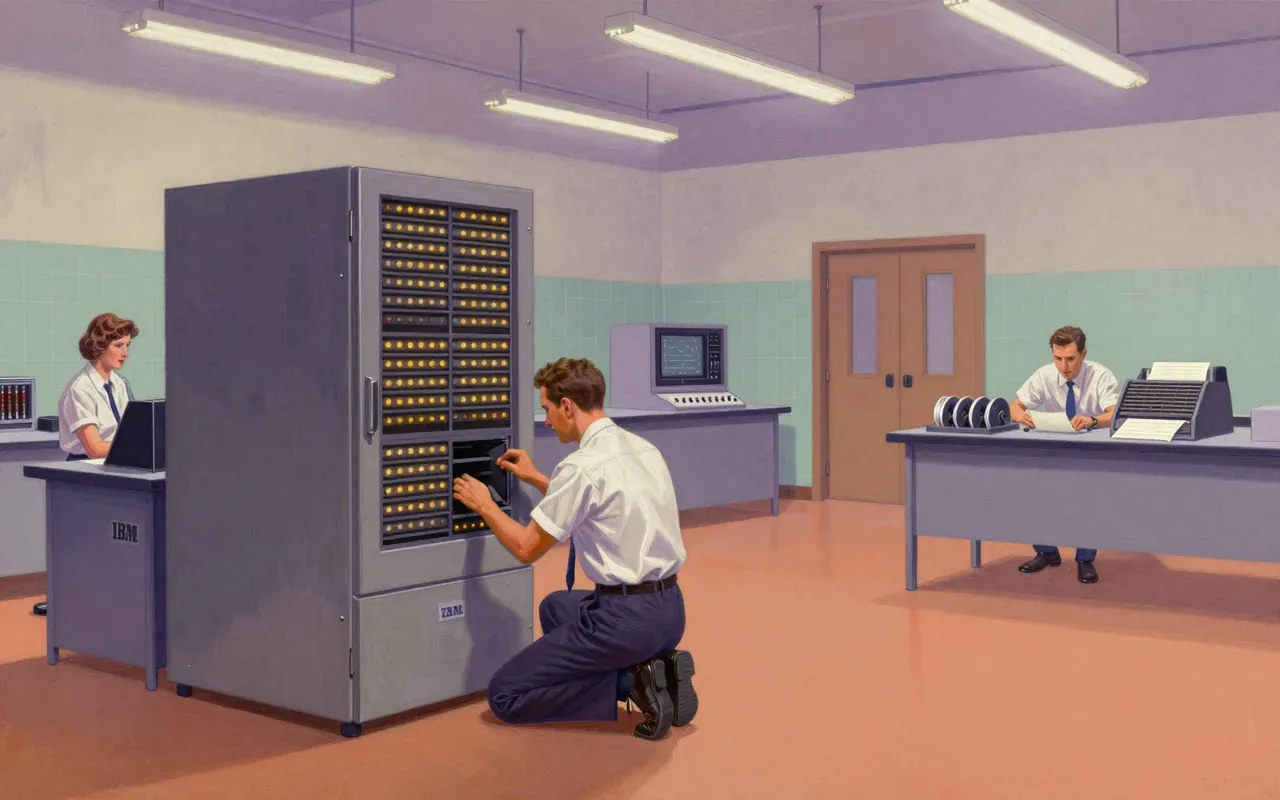
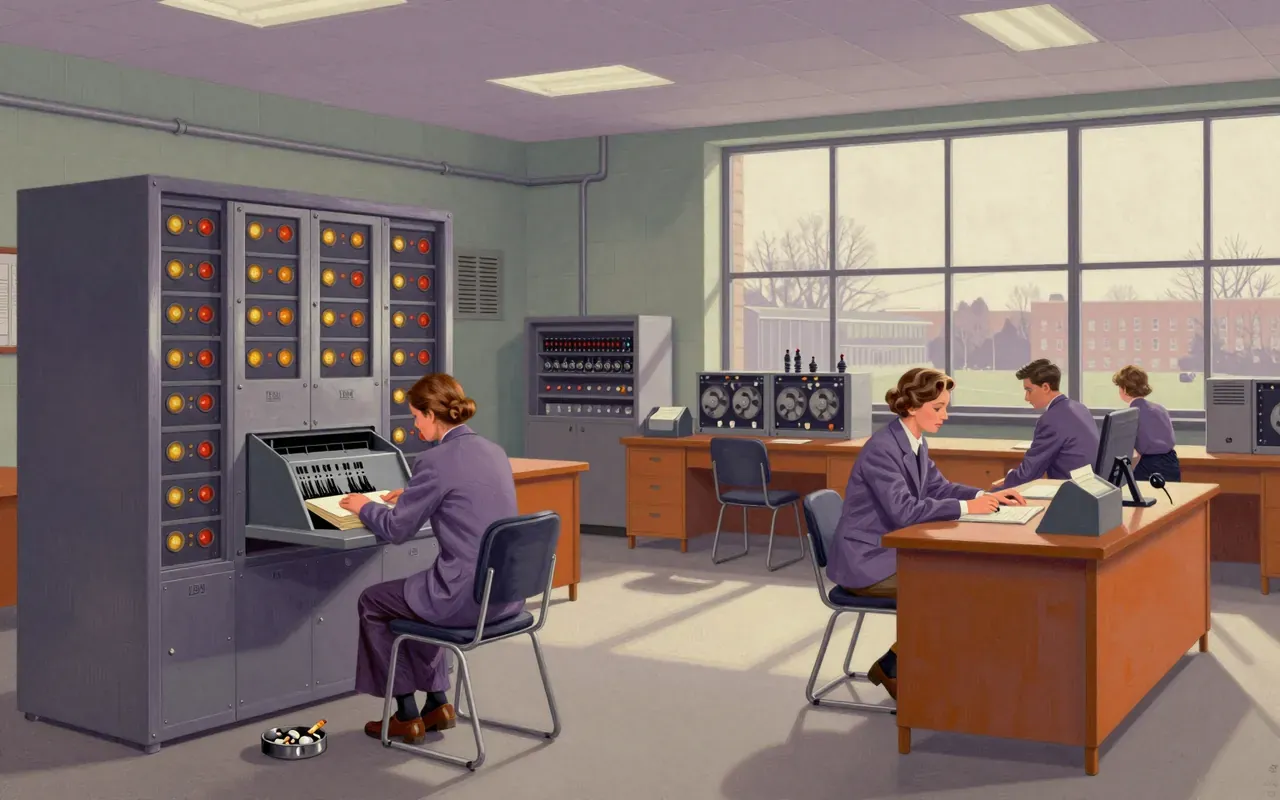
The first Lisp ran on an IBM 704 using punched cards, with eval hand-coded in machine language.
3:12
Self-compiling code
The 1962 compiler—written in Lisp—proved the language could build faster versions of itself.
4:30
Memory management, not magic
Garbage collection arrived before 1962, but as a separate routine—not a seamless part of the runtime.
6:05
Code that reads code
Homoiconicity made Lisp the first language where code could reliably generate, inspect, and modify other code.
7:26
Minimalism with consequences
Lisp established that Turing completeness could emerge from three operators and eval—not from hardware features or complex syntax.
Worth your time?
Yes. Study the whole thing.
4.5/ 5
What works
homoiconicity
runtime metaprogramming
self-hosting compilation
What does not
solve real-time control problems
enable efficient numerical computation
scale to concurrent systems without extension
Study it if
language designers
symbolic AI researchers
compiler engineers
Skip it if
embedded systems developers
web application teams
data pipeline engineers
The written brief1 min read
What it is and the problem it solves
Lisp is a practical mathematical notation for computer programs. It solves the problem of expressing symbolic computation—like algebraic manipulation or theorem proving—in a form that machines can evaluate directly.
How it works
Lisp works by treating code as data: programs are written as nested lists, and the eval function—implemented in machine code on the IBM 704—interprets those lists directly. Homoiconicity means the language’s syntax is its own data structure.
What works
The eval function works. Implemented in machine code on the IBM 704, it produced a working interpreter from day one. Homoiconicity works: code is data, enabling self-modifying programs without syntactic indirection.
What does not
Lisp does not solve performance bottlenecks by default. The interpreter was slow until the 1962 compiler delivered a 40-fold speedup. Garbage collection existed before 1962 but was not yet integrated into a robust, automatic runtime.
What it changes
Lisp changes how programs are built: it enables metaprogramming at runtime, lets code inspect and rewrite itself, and establishes that a language can be defined entirely in terms of a few primitives plus eval.
Is it worth your time
Yes—if you work with symbolic computation, program transformation, or language design. Its mechanisms remain legible and reusable, but its runtime costs and niche abstraction limit broad applicability today.