technologybriefs
11:37in productionCh. 1 · Level 2, Not Level 5/ 11:37 · ceiling 15 min
Robotics · AI

Tesla Autopilot

Tesla Autopilot passes NHTSA’s test — but only because the test measures what Teslas do, not what drivers must still do.

Tesla Autopilot delivers verified Level 2 performance at scale — but conflates fleet telemetry with functional safety, and feature rollout with regulatory progress.

Chapters & takeaways4
  1. 1:22
    Level 2, Not Level 5

    Autopilot is Level 2 — not autonomous, not optional, and standard on every Tesla since April 2019.

  2. 3:01
    The First to Pass

    Model Ys were the first cars to pass NHTSA’s new ADAS benchmark — a milestone tied to real-world behaviour, not design intent.

  3. 4:59
    Ten Billion Miles, Twice

    Ten billion miles of training data and ten billion miles of FSD (Supervised) usage — both measured, both real, both confined to Level 2.

  4. 7:16
    Features Without Certification

    FSD (Supervised) adds features, not authority — and Tesla’s safety claims remain unverified by third parties.

Worth your time?

Yes. Study the whole thing.

3.5/ 5
What works
  • real-time lane-centring and adaptive cruise
  • NHTSA benchmark compliance (May 2026)
  • 10 billion-mile city-street telemetry (FSD Supervised)
What does not
  • enable unsupervised driving
  • meet SAE Level 3+
  • provide independently verified accident reduction
Study it if
  • Tesla owners seeking enhanced highway and city driving assistance
  • fleet operators measuring real-world ADAS adoption
Skip it if
  • drivers expecting hands-off operation
  • regulators assessing certification pathways beyond Level 2
The written brief1 min read

What it is and the problem it solves

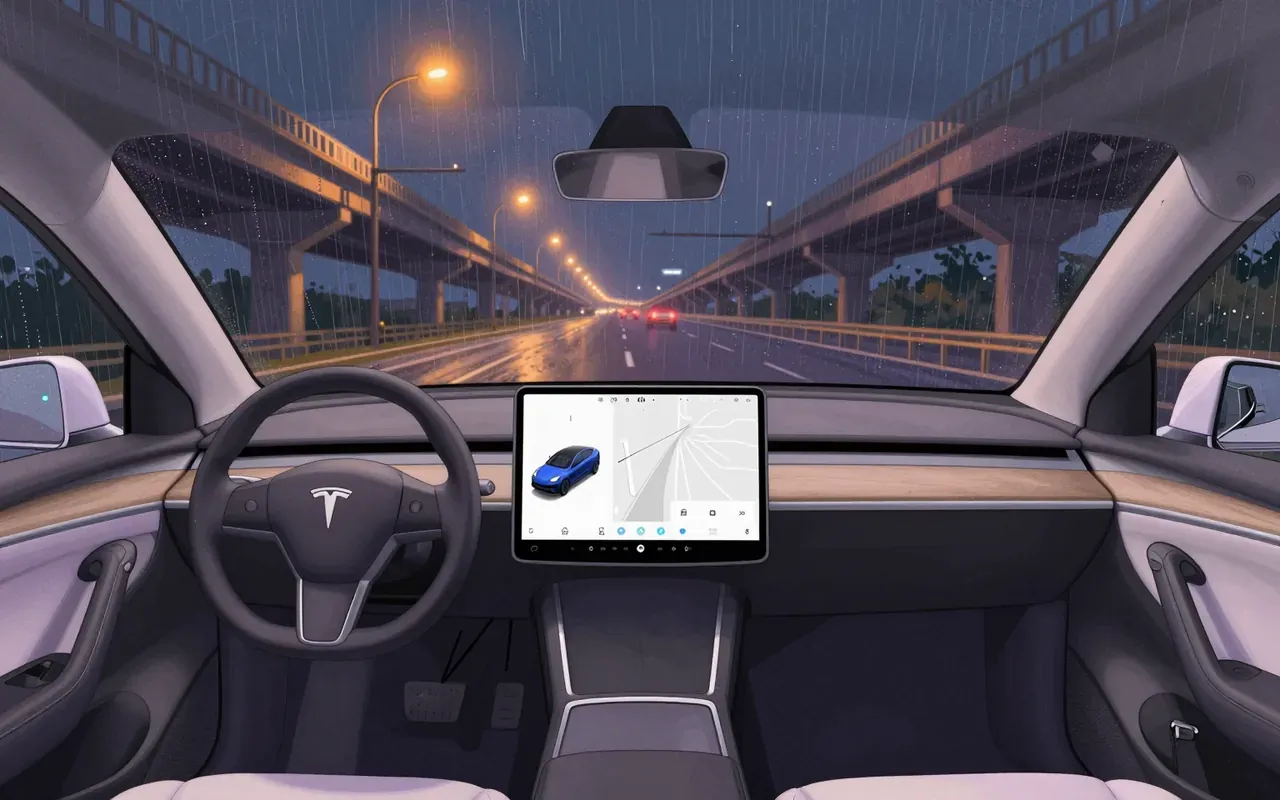
Tesla Autopilot is a Level 2 advanced driver-assistance system. It solves the problem of maintaining lane position and longitudinal control under highway and urban conditions. It does not solve driver engagement — supervision remains mandatory.

How it works

Tesla Autopilot uses camera-based vision and neural networks trained on 10 billion miles of real-world driving data to deliver Level 2 automation. It requires constant driver supervision. It combines autosteer and traffic-aware cruise control. FSD (Supervised), added in February 2026, extends this to semi-autonomous navigation on nearly all roads, self-parking, and summoning — all still Level 2.

What works

Autopilot has operated for 300 million miles by November 2016. Recent Model Ys passed NHTSA’s new ADAS benchmark in May 2026 — the first vehicles to do so. FSD (Supervised) has accumulated 10 billion miles of real-world usage, including 3.7 billion on city streets.

What does not

It does not enable unsupervised driving. It does not meet SAE Level 3 or higher. It does not eliminate driver responsibility. It does not provide verified accident reduction — only Tesla’s internal claim that it reduces fatigue- and inattention-related accidents.

What it changes

It shifts driver-assistance validation from lab testing to real-world fleet telemetry. It establishes city-street autonomy as a measurable milestone — 3.7 billion miles driven with FSD (Supervised) in urban environments by May 2026. It makes Level 2 features standard across an entire vehicle lineup post-April 2019.

Is it worth your time

Yes — if you drive a Tesla and want verified ADAS performance on city streets or highways. No — if you expect hands-off operation, regulatory approval beyond Level 2, or safety claims independently confirmed by NHTSA beyond the May 2026 Model Y benchmark.
Same field · Robotics3 of 3
Up next in Technology

Texas Instruments

1930 · 9:45

Calling 'Texas Instruments (1930)' an invention confuses corporate founding with technological creation — and erases 24 years of actual engineering.

9:45