The first laser was a ruby-powered pulse—not a beam of the future, but a bright, brief, brittle proof.
Theodore Maiman’s 1960 laser is a milestone in quantum electronics—not because it launched applications, but because it proved coherence could be engineered in a solid, at room temperature, using flashlamp excitation. Its limitations are structural: three-level pumping demands high peak power and prevents continuous operation. Its success lies in specificity: 694 nm, pulsed, ruby, May 16, Malibu.
Maiman beat Columbia, Bell Labs, and TRG to working lasing on May 16, 1960—and published it in Nature on August 6.
3:07
Solid-state simplicity
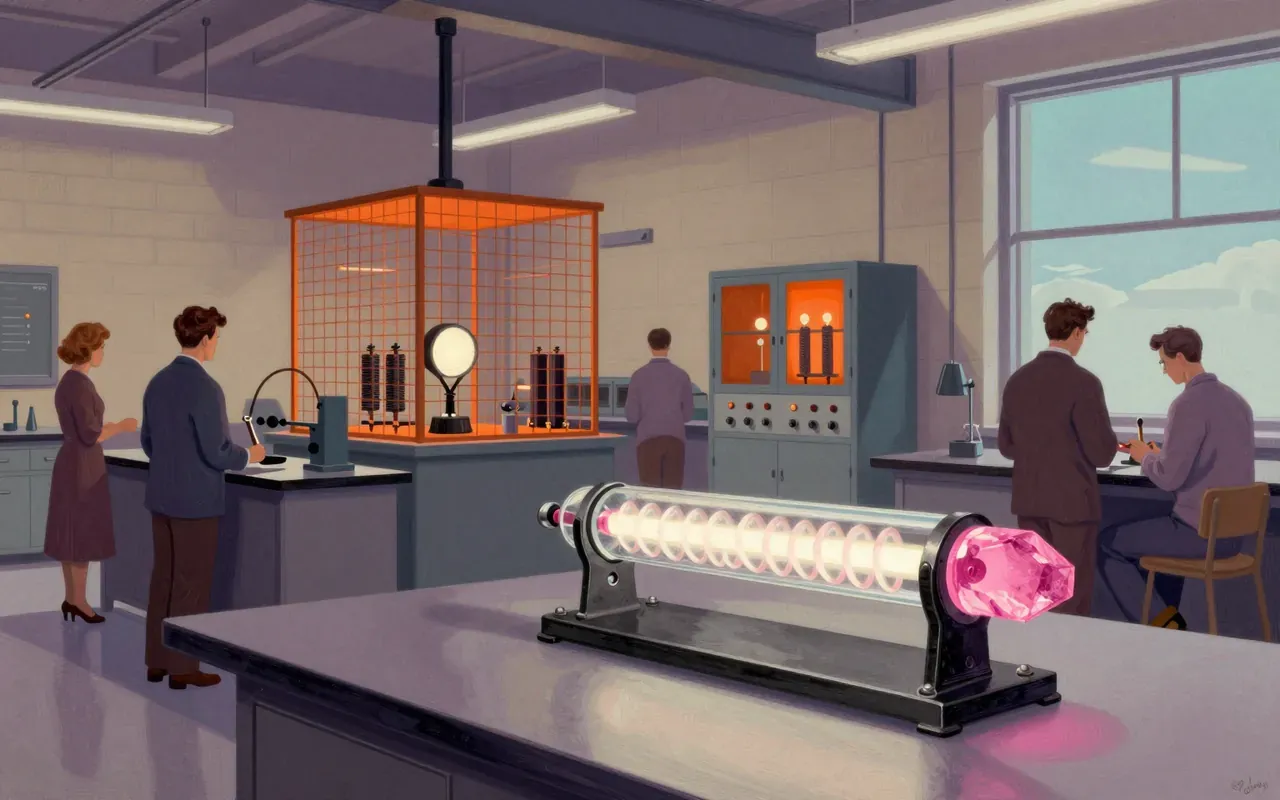
It used a helical xenon flash lamp and synthetic pink ruby—no gas, no mirrors aligned by interferometry, no cryogenics.
4:34
Coherence confirmed
694 nm red light, fully coherent: same wavelength, same phase—proven by spectral line brightness, not theory.
6:20
Threshold, not flow
Pulsed only. Threshold-dependent. Lasing verified by >50× spike in twin-line brightness—not smooth output, but a step-change signal.
Worth your time?
Yes. Study the whole thing.
4.5/ 5
What works
produces coherent red light at 694 nm
confirms stimulated emission in solids
operates as self-contained solid-state device
demonstrates lasing threshold via spectral brightness ratio
What does not
achieve continuous-wave operation
scale to high average power
emit tunable wavelengths
deliver high energy efficiency
Study it if
laser physicists
historians of technology
optical engineers working with pulsed sources
Skip it if
industrial laser system designers
telecom hardware developers
biomedical device integrators requiring CW output
The written brief1 min read
What it is and the problem it solves
A pulsed optical amplifier that solves the problem of generating intense, monochromatic, phase-coherent light. It is not a general-purpose light source—it is a threshold-dependent quantum oscillator.
How it works
It uses a helical xenon flash lamp to pump energy into a synthetic pink ruby crystal. Stimulated emission amplifies light at 694 nm. The crystal’s three-level energy scheme forces pulsed operation.
What works
It emits coherent red light at 694 nm. It confirms lasing via >50× brightness ratio of twin spectral lines above threshold. It operates as a self-contained, flashlamp-pumped solid-state device.
What does not
It does not operate continuously. It does not scale to high average power. It does not emit in tunable or multiple wavelengths. It does not achieve high wall-plug efficiency.
What it changes
It proves stimulated emission can produce coherent light in solids. It shifts laser development from gas and theoretical systems to compact, solid-state devices. It establishes ruby as the first viable laser medium.
Is it worth your time
Yes—if you work with coherent light sources, optical instrumentation, or laser physics history. No—if you need continuous-wave output, efficiency, or scalability beyond proof-of-concept.