What it is and the problem it solves
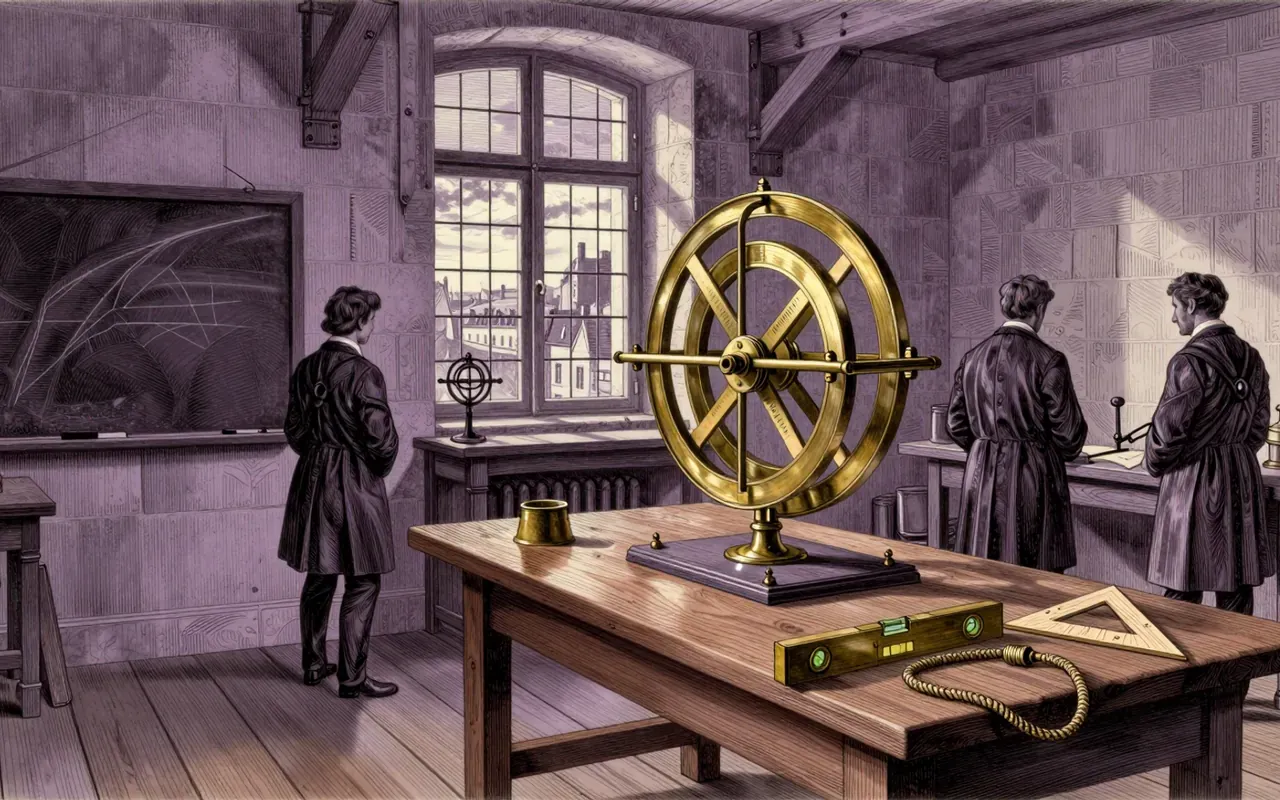
It is a free-spinning rotor mounted on gimbal rings. It solves the problem of making Earth’s rotation directly observable in a fixed laboratory.
The device Foucault used was not his own invention. A gyroscope is essentially a top combined with a pair of gimbals, and tops were invented in many civilisations, including classical Greece, Rome and China, though most were not used as instruments. The first known apparatus similar to a gyroscope was John Serson’s “Whirling Speculum” of 1743, used as a level to find the horizon in foggy or misty conditions. Johann Bohnenberger of Germany wrote in 1817 about a machine based on a rotating massive sphere. In 1832 the American Walter R. Johnson developed a similar device based on a rotating disc. Pierre-Simon Laplace recommended the machine as a teaching aid, which is how it came to Léon Foucault’s attention.
How it works
It spins a rotor on gimbals to isolate rotational inertia. Earth’s rotation causes the spin axis to precess visibly relative to the lab frame.
A gyroscope is a wheel mounted in two or three gimbals that let it rotate about a single axis. With three gimbals, one mounted on the other with orthogonal pivot axes, the wheel on the innermost gimbal keeps an orientation independent of its support. The underlying reason is conservation of angular momentum: the orientation of a spinning axis is unaffected by tilting or rotation of the mounting. Rigidity in space and precession are the two main properties of gyroscopic motion. Precession is induced by torque and is the rate of change of angular momentum produced by an applied torque, and it produces counterintuitive results such as a spinning top not falling over.
What works
The rotor’s angular momentum resists realignment. As Earth rotates, the lab rotates around the fixed spin axis — producing measurable precession for 8–10 minutes.
Foucault’s gyroscope experiment was in 1852, a year after he demonstrated the Earth’s rotation with a long, heavy pendulum hung from the roof of the Panthéon in Paris. That pendulum caused a sensation, and Foucault pendulums were hung in major cities across Europe and America and drew crowds. The Wikipedia biography describes the gyroscope as a conceptually simpler experimental proof, and says Foucault named it. The name joins the Greek for “to see” with the Greek for “circle” or “rotation”, because the experiment let him see the Earth’s rotation. The rotation was visible for the 8 to 10 minutes before friction slowed the spinning rotor.
What does not
It does not sustain observation beyond 8–10 minutes. It does not quantify rotation rate. It does not function as a practical instrument outside controlled demonstration.
What changed that limit was the electric motor. In the 1860s motors made it possible for a gyroscope to spin indefinitely, which led to the first prototype heading indicators and to the gyrocompass. Hermann Anschütz-Kaempfe patented the first functional gyrocompass in 1904, and Elmer Sperry followed with his own design later that year. Engineering the gyroscope remains a challenge: the axle bearings have to be extremely accurate, and a small amount of friction is deliberately introduced because otherwise an accuracy better than 10⁻⁷ of an inch (2.5 nm) would be required.
What it changes
It changes how Earth’s rotation is taught: from abstract inference to visible, local, mechanical evidence — one step simpler than the pendulum.
Foucault was a French physicist born in Paris in 1819 who abandoned medical studies for physics because of a blood phobia. Besides the pendulum and the gyroscope he made an early measurement of the speed of light, discovered eddy currents, and in 1855 received the Copley Medal of the Royal Society. He died in 1868.
Is it worth your time
Only if you need a direct, friction-limited mechanical demonstration of Earth’s rotation — not for navigation, stabilisation or measurement.