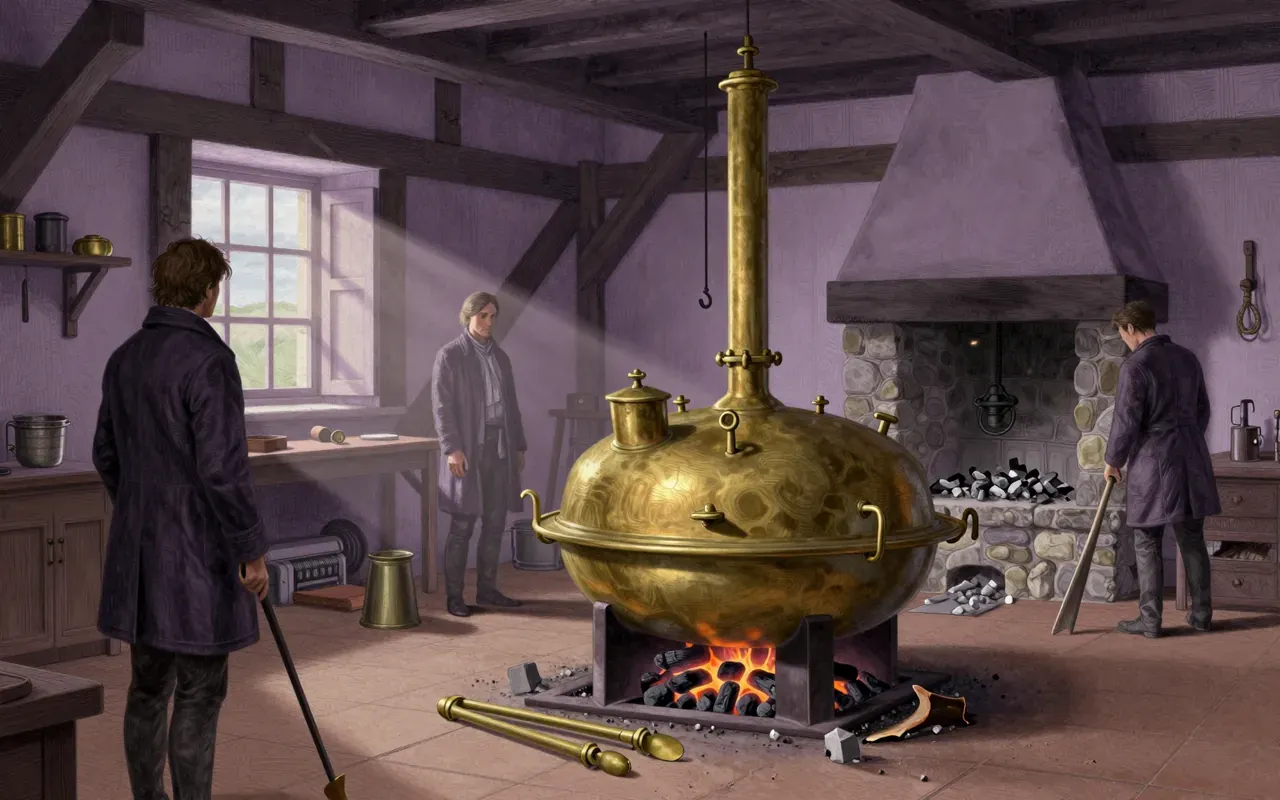
The steam digester is a 1679 experimental vessel that used trapped steam to raise boiling temperature and cut cooking time. It introduced the safety valve and demonstrated atmospheric pressure’s mechanical action — directly enabling Papin’s 1690 piston engine. It was never mass-produced, never used outside demonstration, and had no domestic adoption. Its value is archival and conceptual: it is the first device to treat pressure as a controllable variable in thermal systems.
It solved slow cooking by exploiting physics — not fire, but pressure.
2:08
The valve and the lecture
Its safety valve made it testable — and its presentation made it legible as science.
4:14
The engine before the engine
It was never just a pot — it was the first apparatus to show atmospheric pressure could move pistons.
6:07
Two presentations, one prototype
Papin addressed the Royal Society twice on it — once in 1679, again in 1681 — treating it as evolving research, not a finished product.
1 more chapterFewer chapters
Worth your time?
Yes. Study the whole thing.
4/ 5
What works
raises boiling point
reduces cooking time
demonstrates pressure-work conversion
enables repeatable scientific observation
What does not
cook for households
regulate pressure consistently
survive long-term use without rupture
Study it if
historians of thermodynamics
engineers studying early pressure control
curators of scientific instruments
Skip it if
modern cooks
product designers
food technologists
Who should study it, and who should skipHide who it is for
The written brief1 min read
What it is and the problem it solves
It is the steam digester: Denis Papin’s 1679 airtight vessel designed to reduce cooking time using steam pressure.
How it works
It is an airtight vessel that traps steam to raise water’s boiling point above 100°C, accelerating cooking through higher-temperature thermal transfer.
What works
Raising the boiling point via trapped steam works. The safety valve works — it was integral to the design and enabled controlled pressure release. Its demonstration to the Royal Society worked as scientific communication: Papin was elected a Fellow.
What does not
It does not cook food safely without a safety valve. It does not scale for household use: Papin’s device was experimental, never commercialised, and lacked standardised pressure regulation or user instructions.
What it changes
It changes how heat and phase transitions were studied — turning a kitchen problem into a laboratory probe of gas laws, atmospheric pressure, and thermodynamic work.
Is it worth your time
Yes — if you study how pressure manipulation enables both domestic efficiency and mechanical power conversion, it is foundational. Otherwise, it is a historical footnote with no operational relevance today.