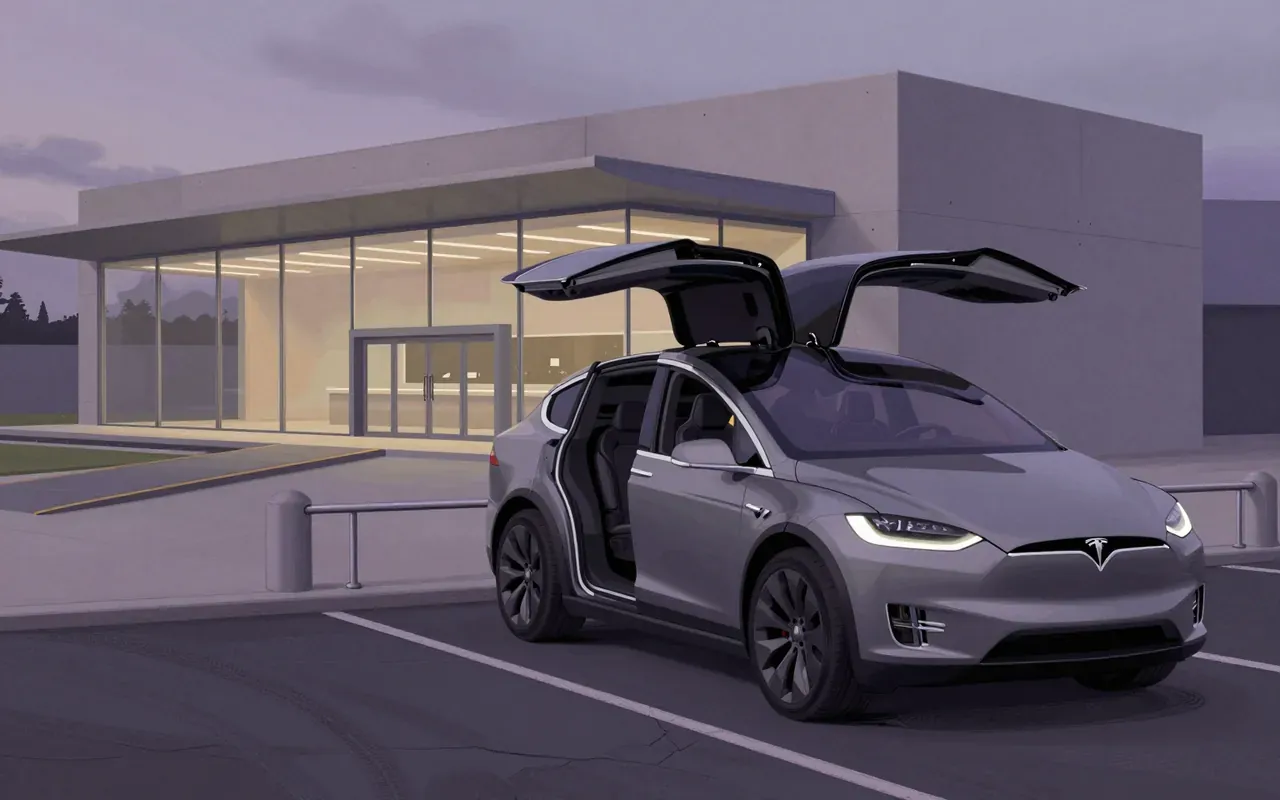
The Tesla Model X is a battery electric mid-size luxury crossover SUV developed from the Model S platform and distinguished by falcon wing doors. It shares ~30% of its parts with the Model S—half the originally planned 60%—and weighs ~10% more. Unveiled in Hawthorne on 9 February 2012, it entered production in Fremont and began deliveries in September 2015. In 2016, it ranked seventh among the world’s best-selling plug-in cars. A 2021 refresh added the Plaid model and updated interior, powertrain, and suspension.
It is a battery electric SUV built on the Model S platform, using falcon wing doors to solve rear access.
2:15
The platform compromise
It shares only ~30% of parts with the Model S and weighs ~10% more—falling short of the intended 60% commonality.
3:19
From prototype to production
Unveiled in Hawthorne on 9 February 2012; first deliveries began in September 2015.
4:47
Market validation, not dominance
It ranked seventh among the world’s best-selling plug-in cars in 2016—its first full year on the market.
6:38
A late-stage evolution
The 2021 refresh introduced Plaid performance and updated interior, powertrain, and suspension.
2 more chaptersFewer chapters
Worth your time?
Yes. Study the whole thing.
3.5/ 5
What works
falcon wing doors deliver functional rear access
Model S platform extension proves viable for SUV class
2016 sales rank confirms early market acceptance
What does not
achieve 60% parts commonality with Model S
eliminate weight penalty versus Model S
dominate global plug-in car sales
Study it if
engineers evaluating platform reuse trade-offs
fleet buyers assessing premium EV utility
policy analysts tracking early luxury EV adoption
Skip it if
budget-conscious EV buyers
mass-market SUV shoppers
those prioritising maximum parts standardisation
Who should study it, and who should skipHide who it is for
The written brief1 min read
What it is and the problem it solves
It is a battery electric mid-size luxury crossover SUV. It solves the problem of rear passenger access in a tall, narrow vehicle without conventional rear-hinged or sliding doors.
How it works
It uses the Model S platform with falcon wing doors for rear access. It shares around 30 percent of its parts with the Model S and weighs about 10 percent more. It is built at the Tesla Factory in Fremont, California.
What works
The falcon wing doors function reliably in constrained spaces. It ranked seventh among the world’s best-selling plug-in cars in 2016—its first full year on the market—proving demand for premium electric SUVs.
What does not
It does not achieve the originally planned 60 percent parts commonality with the Model S. It falls short of full platform efficiency by sharing only half that target—around 30 percent—and carries a weight penalty of ~10 percent.
What it changes
It establishes falcon wing doors as a functional (not just theatrical) solution for tight-space rear access in an SUV body. It confirms that Tesla’s sedan-derived architecture can scale to an EPA-class SUV—but with measurable trade-offs in weight and parts reuse.
Is it worth your time
Yes—if you need a battery electric mid-size luxury crossover SUV with distinctive access and proven market traction among plug-in cars. Its 2021 refresh added Plaid performance and revised systems, but adoption remains niche relative to mass-market EVs.