technologybriefs
10:36in productionCh. 1 · The Brief Was Social, Not Mechanical/ 10:36 · ceiling 15 min
Products · Tech history

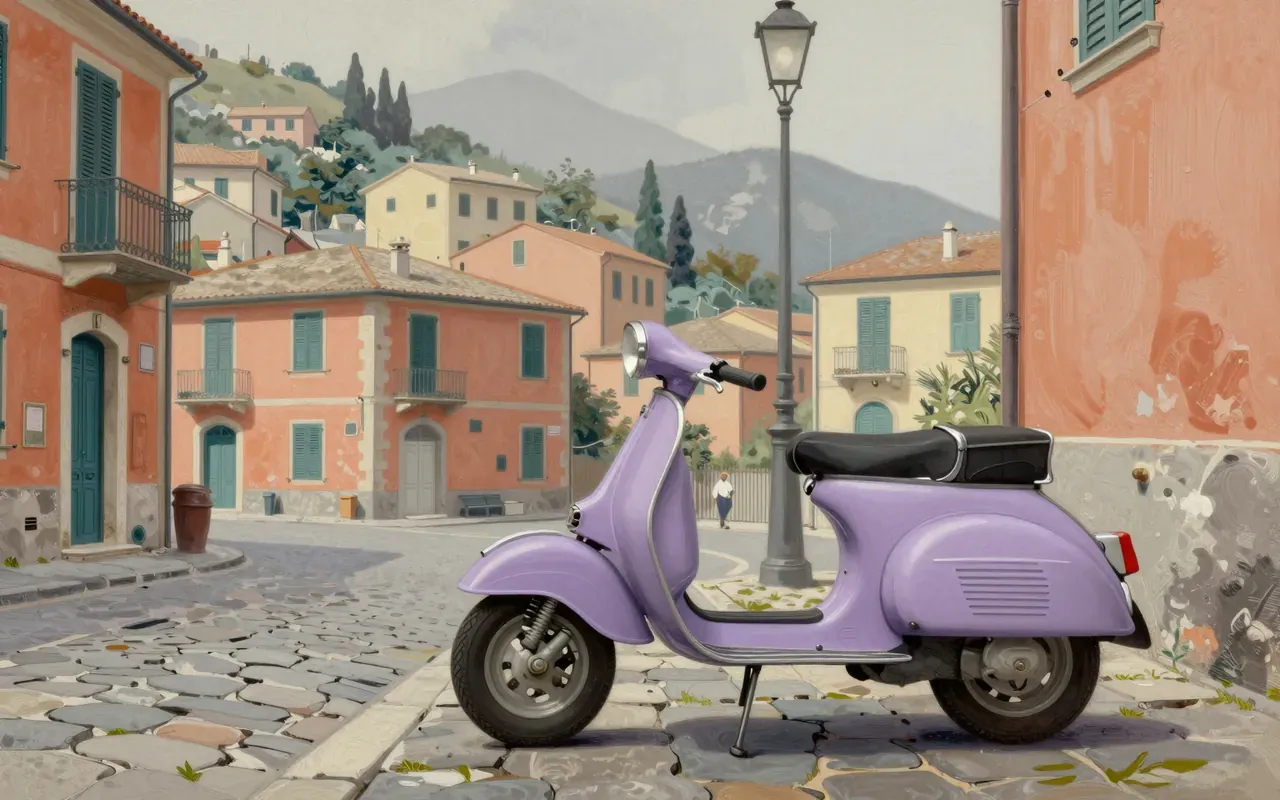
Vespa

The Vespa didn’t invent the scooter—it weaponised sheet metal to make motorised transport socially acceptable.

The Vespa is a product of postwar industrial pragmatism—not engineering ambition. Its pressed steel monocoque, chainless drive, and flat floor solved social barriers to motorised transport: dirt, complexity, and gendered access. It worked because it was cheap to build, easy to maintain, and socially legible. It did not advance powertrain efficiency, suspension dynamics, or materials science. Its legacy is industrial, not technical.

Chapters & takeaways5
  1. 1:02
    The Brief Was Social, Not Mechanical

    Piaggio tasked Corradino D’Ascanio with building a scooter that was simple, robust, affordable, gender-neutral, passenger-capable, and clean—not fast or powerful.

  2. 2:08
    Steel, Not Steel Frame

    Its pressed steel monocoque, chainless direct drive, single-sided fork, and 8-inch wheels were all chosen to eliminate maintenance, dirt, and complexity—not to improve handling or speed.

  3. 3:49
    Cost-Cutting as Design Principle

    Under-seat fuel, optional pillion/storage, and rigid rear suspension prioritised low-cost manufacturing and utility over ride quality or versatility.

  4. 5:05
    Mass Production, Not Mass Innovation

    One million units by 1956 made it Italy’s first mass-produced motorised vehicle—proof the design scaled industrially, not evidence it was technologically superior.

  5. 6:38
    Longevity ≠ Evolution

    Eighteen million units sold since 1946 shows longevity, but every milestone reflects incremental iteration—not structural reinvention.

Worth your time?

Yes. Study the whole thing.

4/ 5
What works
  • enables skirted, clean, passenger-capable riding
  • eliminates chain maintenance and associated grime
  • reduces part count via under-seat fuel access
  • achieves compact layout without sacrificing legroom
What does not
  • advance drivetrain efficiency
  • improve suspension comfort
  • reduce weight versus alternatives
  • enable higher speeds or ranges
Study it if
  • urban planners assessing historical mobility models
  • product designers studying cost-driven integration
  • historians tracing postwar industrial policy
Skip it if
  • engineers seeking performance benchmarks
  • materials scientists evaluating innovation
  • policy makers modelling EV transitions
The written brief2 min read

What it is and the problem it solves

The Vespa is an Italian scooter launched in 1946 by Piaggio to solve postwar mobility: affordable, clean, simple, robust, and usable by all genders. It solves the problem of dirty, complex, intimidating motorcycles by enclosing the engine, flattening the floor, and removing exposed chains and grease.

How it works

The Vespa uses a pressed steel monocoque body that integrates engine cowling, flat floor panel, and front fairing. It drives the rear wheel directly from the transmission, eliminating the chain. Front suspension is single-sided. Rear suspension is rigid. Wheels are 8 inches. The fuel cap sits under the hinged seat to avoid extra locks or metalwork.

What works

The full engine cowling keeps clothes clean. The flat floor panel protects feet and enables skirted riding. The front fairing diverts wind and rain. Direct rear-wheel drive eliminates chain maintenance and grime. Under-seat fuel access reduces part count and cost. Rigid rear suspension and small wheels enable compact packaging with ample legroom.

What does not

It does not solve range, speed, or weather resilience beyond basic wind and rain deflection. It does not scale mechanically: rigid rear suspension limits comfort on rough roads. It does not reduce weight—steel monocoque is heavier than tubular frames. It does not lower cost per unit beyond its initial design choices; later production volumes reflect demand, not inherent affordability.

What it changes

It changes vehicle manufacturing by proving a unified pressed-steel body can replace assembled chassis and bodywork. It changes rider expectations by making motorised transport accessible to people who wear skirts, carry parcels, or lack mechanical confidence. It changes Italy’s industrial identity by delivering the nation’s first mass-produced motorised vehicle.

Is it worth your time

Yes—if you need a durable, low-maintenance urban mobility platform built for mass production, gender-neutral usability, and rider cleanliness. Its industrial scale proves viability, but its mechanical simplicity means it offers no performance or efficiency advantages over later scooters.

Same field · Products4 of 30
12:14
Amazon KindleThe Kindle is a proprietary e-reader platform built around E Ink hardware and Amazon’s closed content store. It delivers portability and battery life at the cost of format lock-in and limited interoperability. Its success rests on vertical integration—not innovation in display or typography.
10:16
Apple II1977The Apple II was a finished 8-bit microcomputer built around the 6502 processor, introduced on June 10, 1977. Designed by Steve Wozniak, it advanced beyond the Apple I in ease of use, features, and expandability. It became widely used in American secondary schools through volume discounts and institutional manufacturing arrangements. VisiCalc’s 1979 release drove adoption among business users and families. It supported text and two colour graphics resolutions, and delivered low-fidelity audio via a software-controlled speaker.
10:12
Apple Watch2015The Apple Watch (2015) is a wrist-worn extension of the iPhone, built for health tracking, notifications, and voice communication. It requires an iPhone for setup and sync but supports independent Wi-Fi and cellular connectivity on higher-tier models. Apple’s API restrictions prevent competing smartwatches from achieving equivalent iPhone integration—making the Apple Watch the only fully supported option. It sold 4.2 million units in its first fiscal quarter and became the world’s best-selling wearable device immediately upon release. As of September 2025, new units ship with watchOS 26 and require an iPhone 11 or later running iOS 26.
10:20
Chevrolet BoltGeneral MotorsThe Chevrolet Bolt EV redefined the mass-market electric vehicle by delivering over 200 miles of range at a $30,000 post-incentive price—verified in production by October 2016. Its development relied on LG for battery and drivetrain, GM for final assembly in Lake Orion, and Israeli engineers for the user interface. Prototype testing covered five key domains. But the sources say nothing about real-world durability, software evolution, charging speed, or cost of ownership.
Up next in Technology

Thunderbolt

· 9:10

A thunderbolt isn’t a port, protocol, or product — it’s a warning drawn in lightning.

9:10