Synthetic rubber began not as a solution, but as a proof: rubber could be made from oil — and nothing else.
Synthetic rubber begins as a chemical demonstration, not an industrial replacement. Hofmann’s 1909 work proves isoprene polymerisation yields rubber — and nothing more. No performance, scale, or economics are stated. Its value lies in reframing rubber as synthesizable — not in delivering a usable material.
It is the first human-made rubber, produced to address dependence on natural rubber sources. It solves no immediate logistical or industrial problem — only a scientific one: can rubber be made without Hevea brasiliensis?
How it works
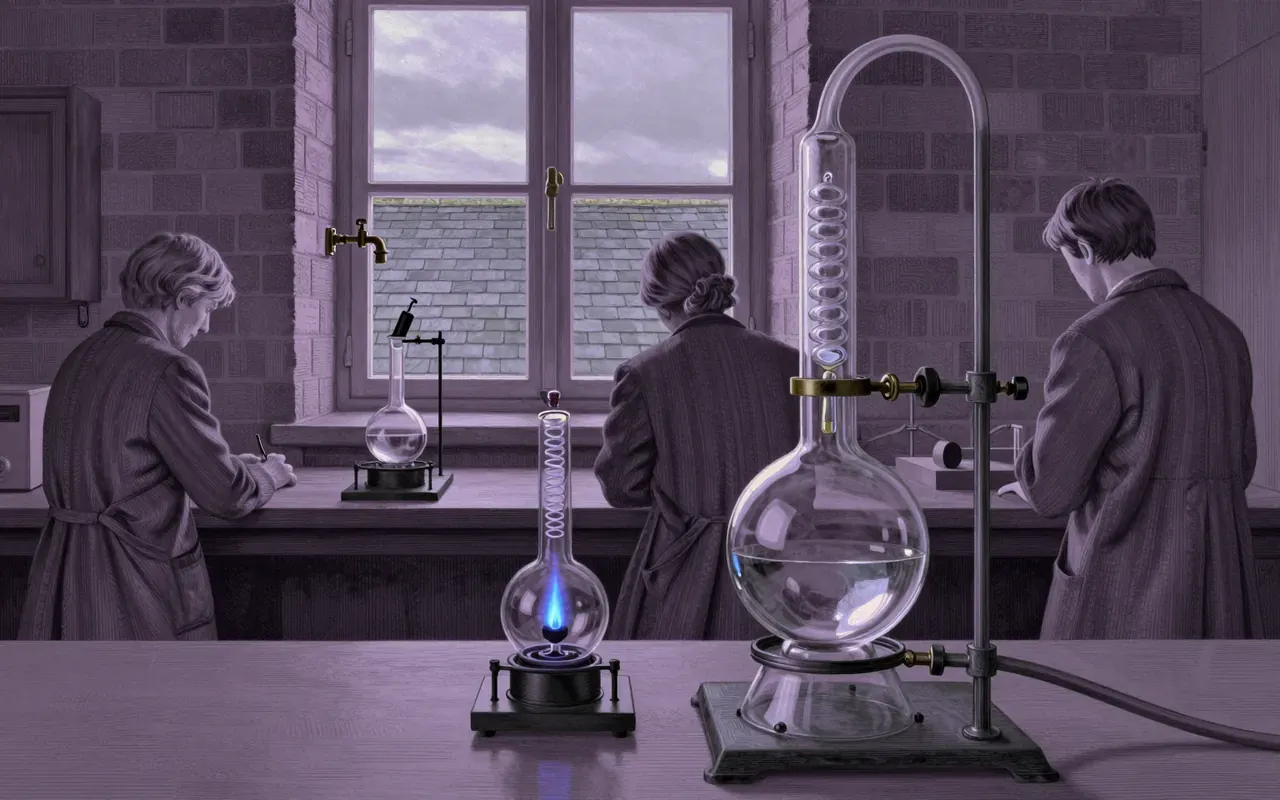
Fritz Hofmann’s team polymerized isoprene — a petroleum-derived monomer — to make rubber. This is the first documented instance of synthetic rubber production.
What works
Polymerising isoprene yields a substance classified as rubber. The method allows control over molecular weight and properties — per the document — but no specific property values or control mechanisms are given.
What does not
The document does not state that this synthetic rubber matched natural rubber in elasticity, durability, or processability. It does not say it was commercialised, scaled, or adopted.
What it changes
It changes the conceptual boundary of rubber from a harvested biological product to a synthesised industrial one. It proves isoprene polymerisation yields rubber-like material — nothing more.
Is it worth your time
Yes, if you work on materials science, polymer chemistry, or supply-chain resilience. It establishes petroleum-based monomer polymerization as a viable route to elastomers — but offers no performance data, scalability details, or cost metrics.