technologybriefs
Topic

Materials

Every era is named after one, which should be a clue.

15
in technology
9:59
average
150 min
in total
138
across the network
Materials across the network →
All briefs15
9:38

3D printing

Chuck Hull

Chuck Hull’s stereolithography system is the origin point of digital additive manufacturing—not because it printed everything, but because it defined how digital models become physical things: via slicing, STL, and controlled solidification. It works for prototyping. It fails for production. Its legacy is infrastructural, not material.

11:39

Solid-state battery

Solid-state batteries deliver real gains in safety and speed — but they are not shipping, not scaling, and not replacing anything yet.
10:54

Gorilla Glass

It doesn’t make glass unbreakable—it makes breakage predictable, controllable, and commercially viable.
10:01

Iridium

Iridium isn’t rare because it’s special — it’s special because it’s rare, and that rarity locks its utility into three narrow, high-stakes industrial niches.
10:16

Applied Materials

Applied Materials doesn’t make chips—it makes the machines that force atoms into place, one layer at a time.
11:20

ISO metric screw thread

International Organization for Standardization

The ISO metric screw thread is a foundational hardware standard that enforces dimensional predictability across global manufacturing. Its value lies not in novelty but in binding force: once adopted, divergence carries real cost. It works where geometry matters more than brand—and fails where tolerance, material, or practice undermines its assumptions.

9:21

Polyvinyl chloride

Waldo Semon

Waldo Semon did not invent PVC. He invented how to make it behave. His 1926 method — blending it with additives like dibutyl phthalate — converted a brittle, unprocessable polymer into something elastic and non-adhesive. That enabled Koroseal: a salt-coke-limestone-derived polymer whose consistency could be set deliberately. It did not fix PVC’s thermal instability or environmental persistence. Its real innovation was tunability — proving synthetic polymers could be governed, not just discovered.

10:00

Prestressed concrete

Eugène Freyssinet

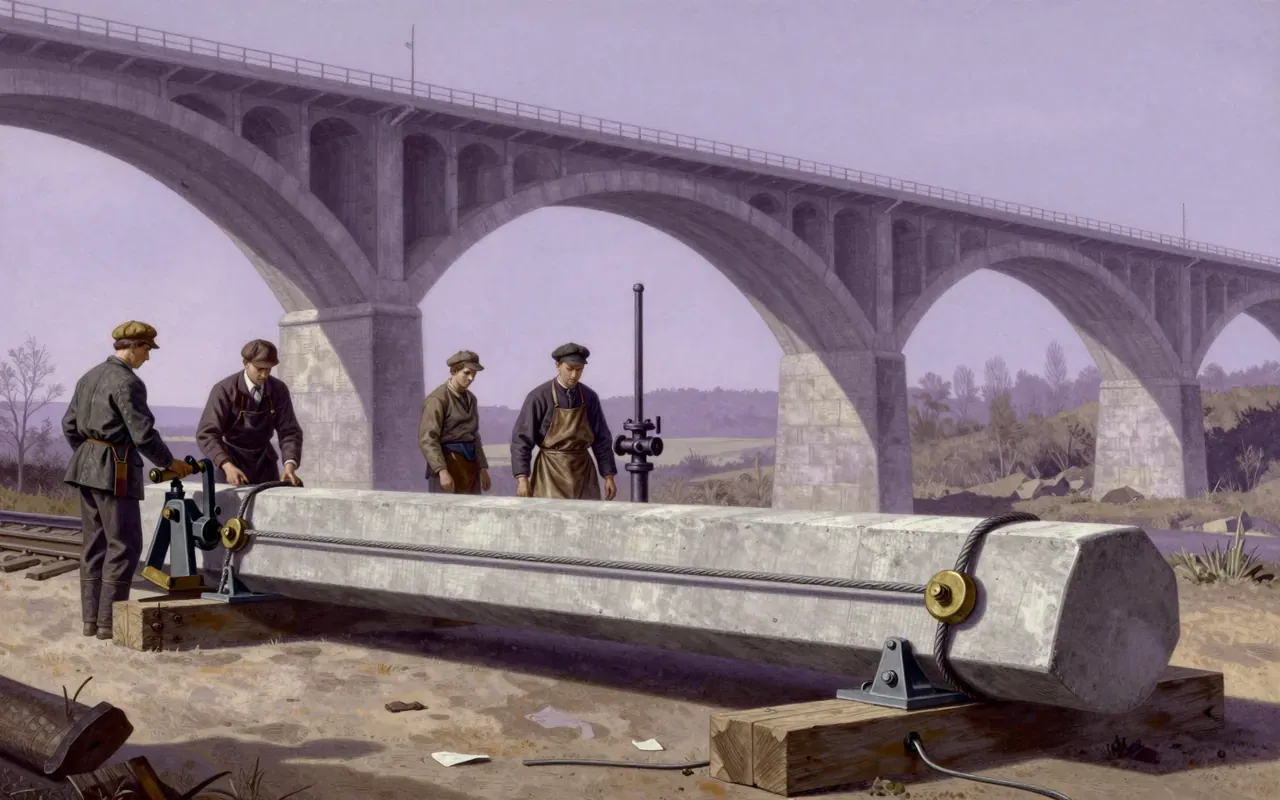
Prestressed concrete redefines concrete’s role in tension-critical structures—not by making it stronger, but by ensuring it never has to carry tension alone.

9:12

Reinforced concrete

Joseph Monier · 1853

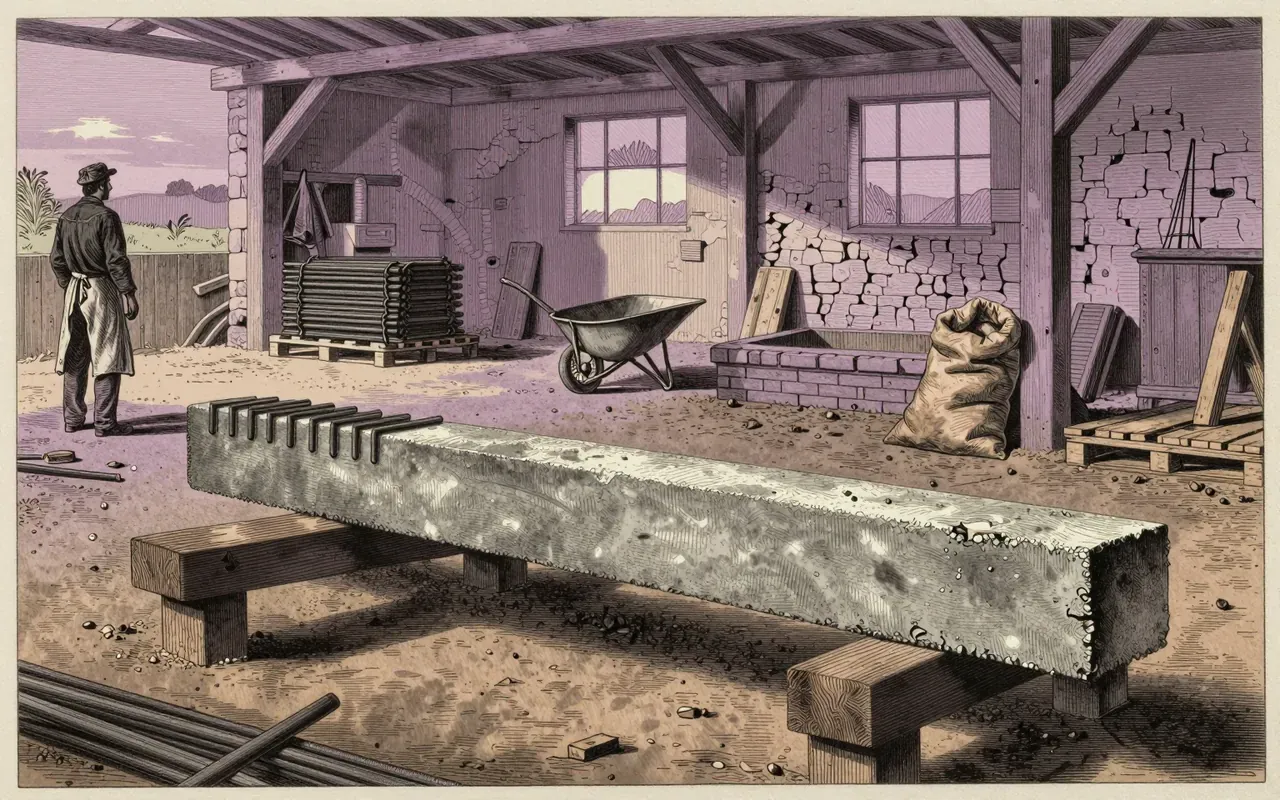
Reinforced concrete is not a theoretical breakthrough—it is a gardener’s empirical fix scaled into infrastructure. Monier solved flowerpot instability by embedding iron, then patented successive forms (wire mesh in 1867, iron rods in 1877) without quantifying mechanical gains. He proved thermal compatibility and rust protection through experiment—not calculation. His method enabled T-beams and pipes by 1878, but left tensile improvement unmeasured and corrosion science unexplored. It matters today because it reveals how material innovation begins in constraint, not abstraction.

9:10

Synthetic rubber

Fritz Hofmann

Synthetic rubber begins as a chemical demonstration, not an industrial replacement. Hofmann’s 1909 work proves isoprene polymerisation yields rubber — and nothing more. No performance, scale, or economics are stated. Its value lies in reframing rubber as synthesizable — not in delivering a usable material.

10:03

Bessemer process

Henry Bessemer · 1855

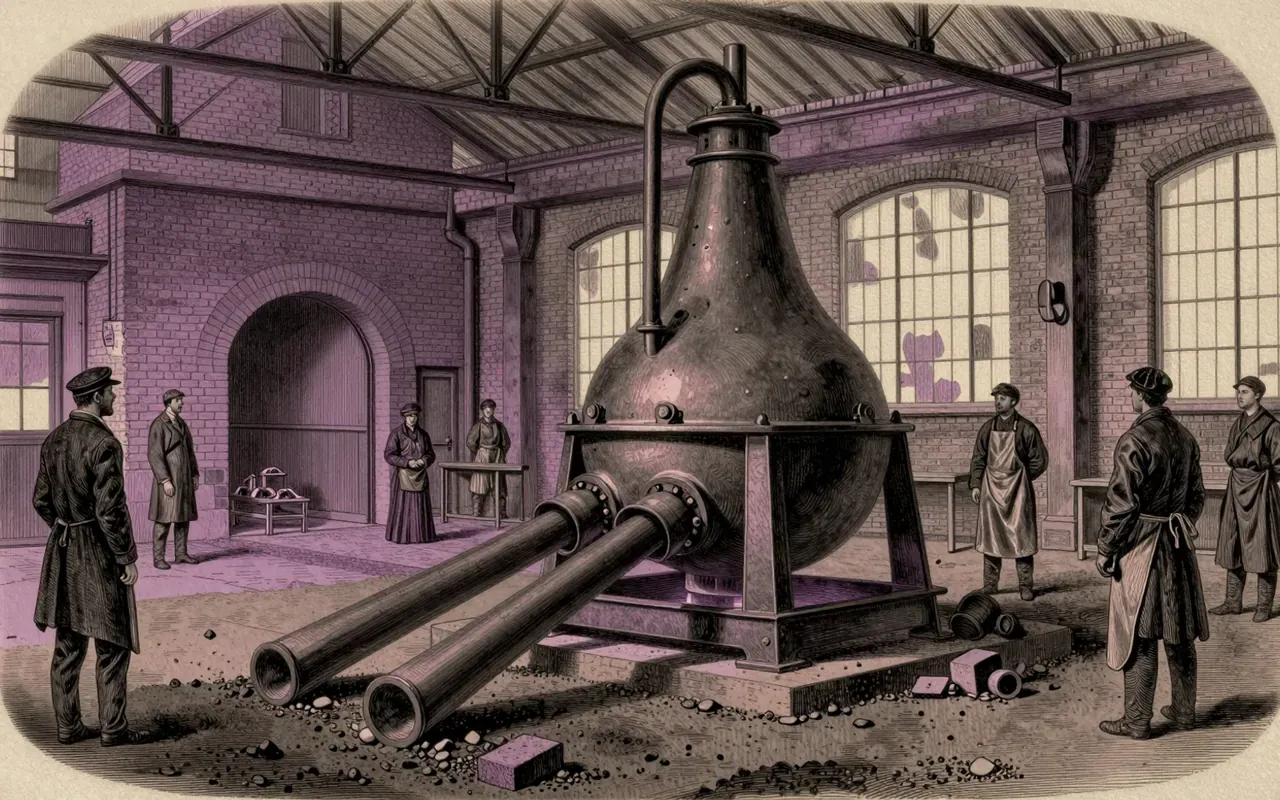
The Bessemer process is the first industrial method to mass-produce steel cheaply — by blowing air through molten pig iron to oxidise impurities, especially carbon. It works by self-heating oxidation, cuts batch time from a day to under 20 minutes, and forces deliberate carbon readdition. It fails to deliver finished steel in one step and cannot treat phosphorus-rich iron without later refinement. It changed structural engineering by enabling steel’s substitution for cast and wrought iron. It remains foundational — not because it endures, but because it proved scalable metallurgical control was possible.

9:00

Liquid-crystal display

George H. Heilmeier

The Liquid-crystal display (LCD) invented by George H. Heilmeier at RCA in 1964 was the first operational display based on dynamic scattering mode (DSM). It solved the problem of achieving solid-state visual output by exploiting field-induced light scattering in liquid crystals — not alignment-based modulation. DSM works by applying voltage to switch the layer from transparent to turbid, enabling rudimentary on/off display states in transmissive or reflective modes. It required considerable current, limiting practical use. Though credited as the invention of the LCD, DSM was superseded within a decade due to its power demands and lack of scalability. It changed display R&D by proving liquid crystals could be electrically switched, but it did not deliver on low-power, high-density, or long-life promises.
10:53

Strain gauge

Edward E. Simmons and Arthur C. Ruge

The strain gauge is a bonded metallic foil sensor that translates mechanical strain into resistance change via conductor geometry. Invented independently in 1938 by Simmons (for shock-load metallurgy) and Ruge (for seismological water tank modelling), it solved measurement gaps where optical methods failed. It works reliably within elastic limits—but fails without precise adhesion or thermal control. Its legacy is not novelty but adoption: it became the standard interface between force and electronics because it was simple, scalable, and grounded in first principles—not hype.

8:33

Thermistor

Samuel Ruben · 1833

The thermistor is a semiconductor resistor whose resistance changes strongly with temperature. Michael Faraday discovered its NTC behaviour in silver sulfide in 1833. Commercial production did not begin until the 1930s due to manufacturing difficulty and limited applications. Samuel Ruben invented a commercially viable version in 1930.