What it is and the problem it solves
A machine that generates compressive force using hydraulic cylinders. It solves the problem of applying large, steady pressure where mechanical levers are impractical or insufficient.
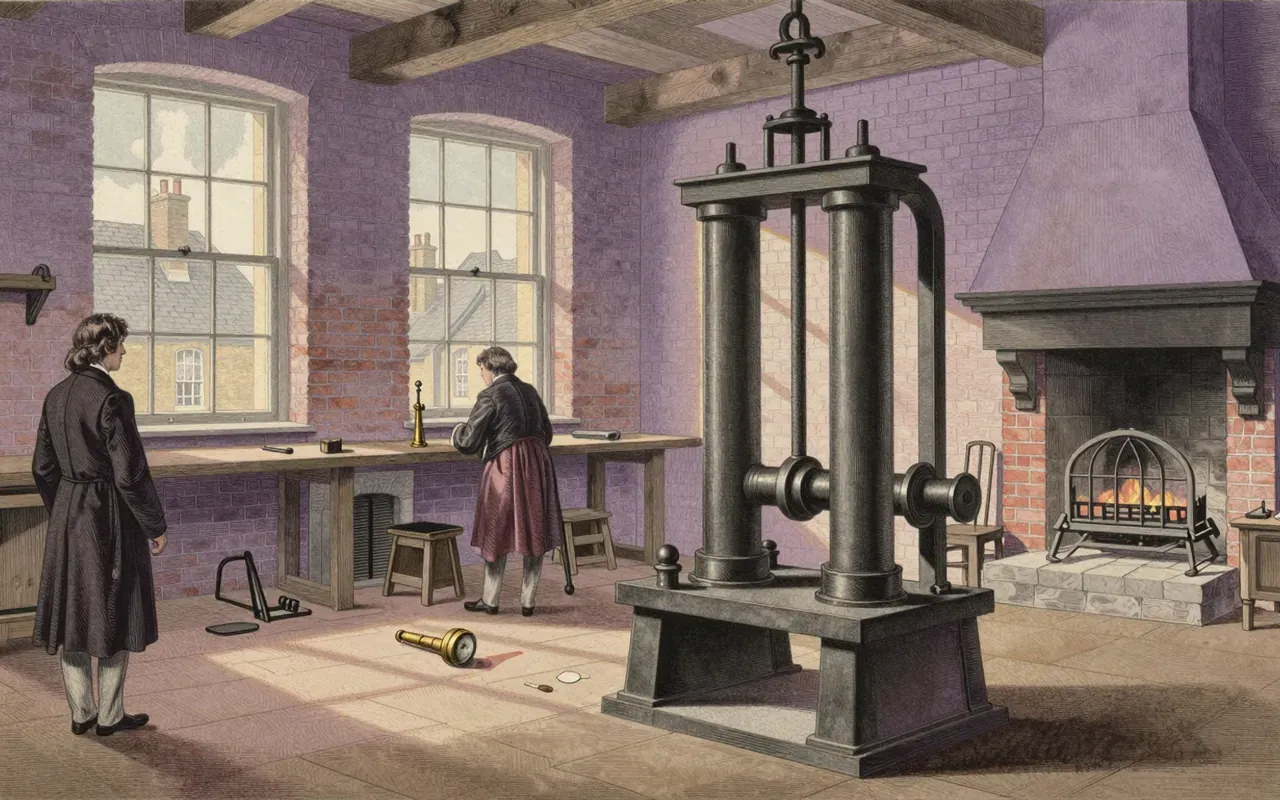
The press is the hydraulic equivalent of a mechanical lever and was also known as the Bramah press, after the English inventor Joseph Bramah, who patented it in 1795. Bramah, born in 1748, was a locksmith and improver of the flush toilet, and he studied existing literature on the motion of fluids to develop the press. The Wikipedia biography calls it his most important invention. It adds that when he was bringing the idea to fruition, hydraulic engineering was an almost unknown science, with Bramah and William Armstrong, 1st Baron Armstrong, as its two pioneers.
How it works
It uses two pistons of unequal cross-sectional area in a closed hydraulic system. A modest force on the small piston creates pressure that remains constant across the system. That same pressure acts on the larger piston, generating proportionally greater compressive force.
Bramah’s press had two cylinders and pistons of different cross-sectional area, so a force on the smaller piston became a larger force on the larger one. If the pump is kept separate from the press cylinder, only small-diameter tubing, which more easily resists pressure, is needed to connect them.
What works
Pascal’s principle holds: pressure remains constant in the closed system. Force amplification scales precisely with the ratio of piston areas. The cylinder-and-piston mechanism delivers repeatable, proportional output.
Hydraulic presses are commonly used to assemble and disassemble tightly fitting components. In manufacturing it is used for forging, clinching, molding, blanking, punching, deep drawing and metal forming, plus stretch forming, rubber pad forming and powder compacting. The press can create more intricate shapes than other methods, can be economical with materials, and takes up less space than a mechanical press of the same capability. It is also used in garbage trucks and car crushers to shrink waste for easier transport. In geology, a tungsten carbide coated hydraulic press is used to crush rock when preparing samples for geochemical analysis.
What does not
It does not eliminate friction, leakage, or seal failure. It does not scale linearly at extreme pressures without material limits. It does not generate motion—only static compression.
What it changes
It changes how force is amplified: from gear trains and levers to fluid-mediated transmission. It enables consistent, controllable, high-ratio force multiplication in industrial settings.
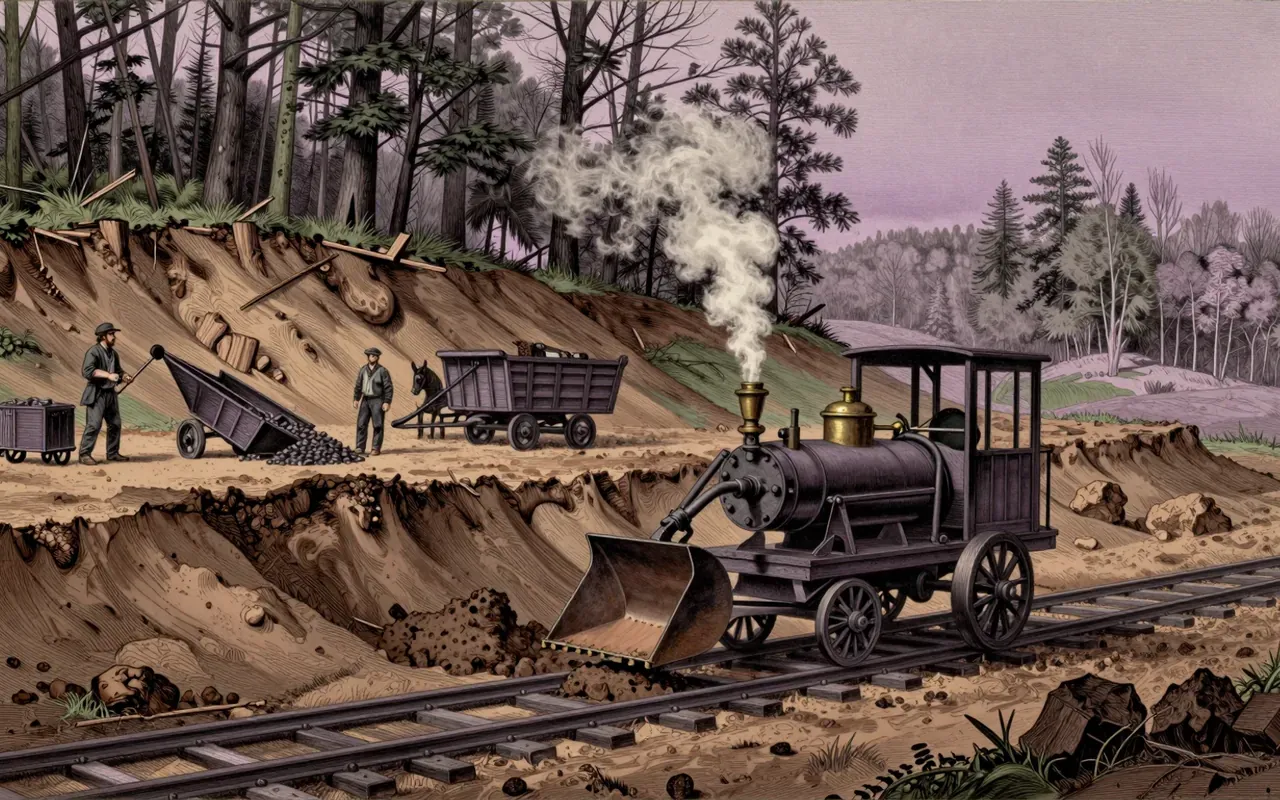
Bramah worked on a large scale as well. One of his last inventions was a hydrostatic press capable of uprooting trees, which was put to work at Holt Forest in Hampshire, and in 1812 he patented public water mains and high-pressure hydraulic mains. He died at Holt Forest on 9 December 1814 of pneumonia, after catching a cold while supervising that work. The press is still known as the Bramah press, and it had many industrial applications and still does.
It has also entered popular culture. A hydraulic press features in the Sherlock Holmes story “The Adventure of the Engineer’s Thumb”. The Hydraulic Press Channel, a YouTube channel about crushing objects, was created in 2015 by Lauri Vuohensilta, a factory owner from Tampere, Finland, and it has grown to over 10 million subscribers.
Is it worth your time
Yes—if you need high compressive force without mechanical complexity or large input effort. It demands no electricity, no combustion, and no moving parts beyond pistons and fluid seals.