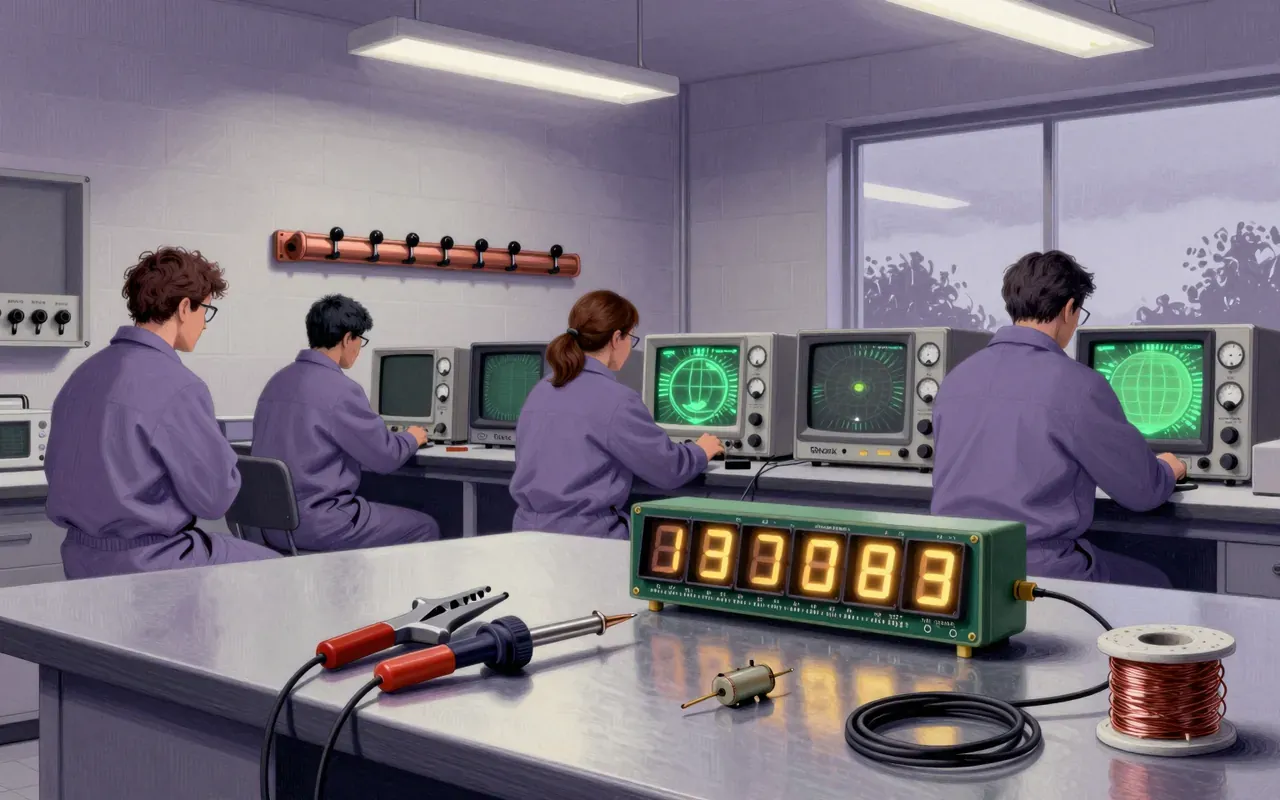
Nick Holonyak didn’t invent the LED display — he invented the LED that made it possible, and HP built the first one that actually worked.
The LED display is not Holonyak’s invention — it is HP’s. Holonyak’s 1962 GaAsP LED enabled it. HP’s 1969 Model 5082-7000 was the first intelligent, IC-integrated numeric display — fast, solid-state, low-power, and monochromatic. It displaced Nixie tubes but could not render text, graphics, or colour. Later all-LED flat panels remained monochrome and experimental.
Holonyak’s 1962 GaAsP diode was the first practical visible-light LED — red-emitting, room-temperature functional, and commercially scalable.
2:55
HP built the first working display
HP delivered the first practical LED display in 1968, culminating in the February 1969 Model 5082-7000 — the first intelligent, IC-integrated numeric indicator.
4:24
Intelligent, but monochromatic
It replaced Nixie tubes by integrating logic and light emission on one package — but only showed numbers, and only in one colour.
6:00
Flat-panel came later, and stayed monochrome
A 1977 all-LED flat-panel TV screen existed — but it was monochromatic and never commercialised.
Worth your time?
Yes. Study the whole thing.
4/ 5
What works
replaces Nixie tubes reliably
integrates logic and light in one package
operates at low voltage with high switching speed
What does not
deliver colour
support alphanumeric characters
integrate driver logic beyond numeric decoding
Study it if
embedded systems engineers
industrial interface designers
retro-computing restorers
Skip it if
UI designers building modern dashboards
video hardware architects
consumer display marketers
The written brief1 min read
What it is and the problem it solves
An electronic display that emits light when current passes through a semiconductor. It solves the problem of bulky, power-hungry, fragile vacuum-tube numeric indicators.
How it works
It converts electrical current directly into visible light using semiconductor junctions made from gallium arsenide phosphide (GaAsP) crystals.
What works
The HP Model 5082-7000 Numeric Indicator works as an intelligent LED display: it accepts binary-coded decimal input and drives its own seven-segment digits using integrated circuit technology.
What does not
It does not produce full-colour images natively. Early models were monochromatic by design, and colour capability required later multi-junction devices and driver circuitry not present in the 1969 HP Model 5082-7000.
What it changes
It replaces Nixie tubes in digital instrumentation, enabling smaller, faster, lower-voltage, solid-state numeric readouts integrated directly with logic circuits.
Is it worth your time
Yes — if you work with digital displays, embedded interfaces, or low-power indicator systems, the LED display’s reliability, speed, and integration with ICs remain foundational.