9:55in productionCh. 1 · 1979: A treaty, not a launch/ 9:55 · ceiling 15 min
Systems · Tech history
Inmarsat
1979
A satellite network built for ships became the world’s first lifeline for remote operations—and its compromises still define what ‘global’ really means for connectivity.
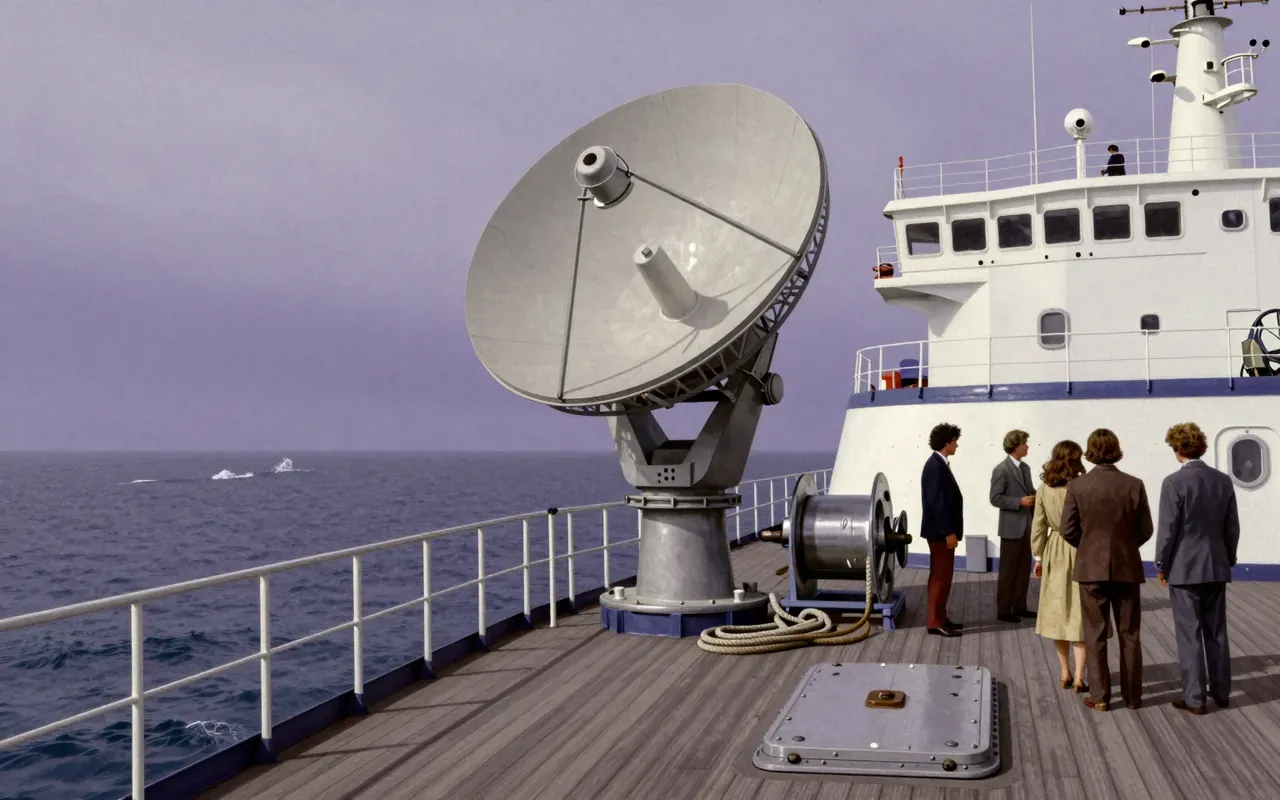
Inmarsat is a British satellite telecommunications company originating from the 1979 intergovernmental International Maritime Satellite Organization (INMARSAT), established to provide satellite communications for the maritime community. It evolved to serve aviation, government, aid, media, and industry sectors in remote or terrestrial-network-limited areas. Its operational business was privatised in 1999 as Inmarsat Ltd., becoming the first international satellite organisation to undergo privatisation. It delivers services via geostationary satellites — initially using Marisat and MARECS, then dedicated constellations (Inmarsat-2, Inmarsat-3), followed by BGAN (via Inmarsat-4), Global Xpress (I-5), and later Inmarsat-6 and Inmarsat-8 satellites — supporting voice, data, distress/safety (GMDSS), and IoT/M2M applications globally.
It began as a treaty-bound maritime utility—not a tech startup.
2:30
How it reaches the unreachable
Fifteen geostationary satellites serve users who cannot rely on any other network.
4:52
From intergovernmental body to UK plc
Privatisation in 1999 split public safety obligations from commercial operations.
6:30
What it actually carries
It delivers voice and data—not streaming, not cloud sync, not video calls.
Worth your time?
Yes. Study the whole thing.
4/ 5
What works
distress signalling (GMDSS)
portable voice and data in zero-coverage zones
interoperable safety comms across jurisdictions
What does not
high-bandwidth
low-latency
mass consumer broadband
Study it if
maritime operators
airline safety teams
field journalists
Skip it if
remote office workers
streaming users
cloud-dependent developers
The written brief1 min read
What it is and the problem it solves
Inmarsat is a British satellite telecommunications company born in 1979 as the intergovernmental International Maritime Satellite Organization. It solves the problem of voice and data communication for ships beyond VHF range—where no terrestrial infrastructure exists.
How it works
Inmarsat uses geostationary satellites to relay voice and data between portable or mobile terminals and ground stations. It began with Marisat and MARECS, then deployed dedicated constellations: Inmarsat-2, Inmarsat-3, BGAN (via Inmarsat-4), Global Xpress (I-5), and later Inmarsat-6 and Inmarsat-8.
What works
Its GMDSS service delivers mandatory, globally interoperable distress alerting and safety messaging for maritime users. Its BGAN and Global Xpress services deliver portable broadband and voice to aircraft, journalists, and aid workers in deserts, oceans, and mountains.
What does not
It does not provide ubiquitous, low-cost, high-speed internet. Its geostationary architecture imposes latency, limited bandwidth per user, and coverage gaps at extreme latitudes. It was never designed for mass consumer use.
What it changes
It changes how remote operations coordinate—enabling real-time distress signalling (GMDSS), airborne safety comms, and field reporting from disaster zones or conflict areas. It shifts dependency from coastal radio and HF from ships to satellite-based assured connectivity.
Is it worth your time
Yes—if your work requires reliable comms where terrestrial networks fail, especially in maritime, aviation, government, aid, media or mining operations. No—if you need high-bandwidth, low-latency, or cost-sensitive broadband.