technologybriefs
10:57in productionCh. 1 · Where it sits/ 10:57 · ceiling 15 min
Hardware · Tech history

Pratt & Whitney

1925

Pratt & Whitney isn’t about innovation—it’s about infrastructure: a century of engines built to be rebuilt, not replaced.

Pratt & Whitney delivers certified, field-serviced propulsion hardware—not AI-driven autonomy, not software-defined flight, not carbon-neutral combustion. Its value lies in repeatable engineering, global logistics, and decades of installed base leverage.

Chapters & takeaways6
  1. 0:59
    Where it sits

    Pratt & Whitney is an American aerospace manufacturer headquartered in East Hartford, Connecticut, and owned by RTX Corporation.

  2. 2:05
    Where it began

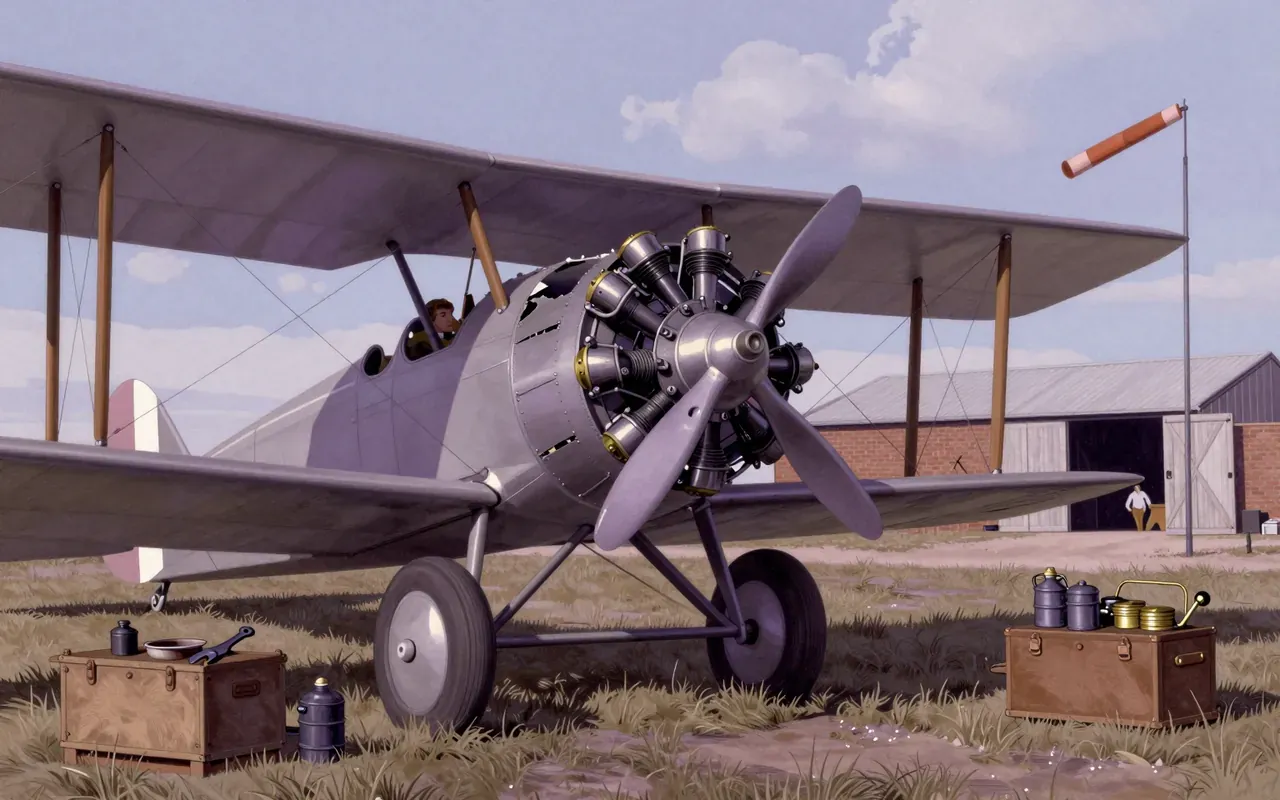
    Its first engine—the R-1340 Wasp—was completed on Christmas Eve 1925, establishing its foundational radial design.

  3. 3:18
    Where it stands

    As of 2020, it holds 35% of the commercial aircraft engine market—second only to GE Aerospace.

  4. 4:36
    Where it operates

    In 2017, it supported over 11,000 customers across 180 countries—proof of global service reach.

  5. 6:11
    Where it runs

    Its engines power civil airliners, military aircraft, industrial plants, marine vessels, and power generation systems.

  6. 7:28
    What it solves

    It solves propulsion—but only for applications where certification, durability, and serviceability outweigh agility or novelty.

Worth your time?

Yes. Study the whole thing.

4/ 5
What works
  • certified engine production
  • global spare-parts logistics
  • long-cycle engine overhaul networks
What does not
  • AI integration
  • emissions reduction claims
  • digital twin deployment
  • software-defined control architecture
Study it if
  • aircraft maintenance engineers
  • fleet planners
  • power-generation OEMs
Skip it if
  • AI researchers
  • climate policy analysts
  • startup founders in mobility-as-a-service
The written brief1 min read

What it is and the problem it solves

Pratt & Whitney is an American aerospace manufacturer solving propulsion: turning fuel into controlled rotational force for flight and mechanical drive. It exists to deliver certified, maintainable, field-deployed powerplants.

How it works

Pratt & Whitney builds aircraft and gas turbine engines. It integrates mechanical design, materials science, and combustion engineering into rotating assemblies that generate thrust or shaft power.

What works

Its R-1340 Wasp established a scalable radial engine architecture in 1925. Its 2020 35% commercial market share confirms sustained adoption. Its 2017 support of 11,000+ customers across 180 countries proves global service infrastructure works.

What does not

The material says nothing about emissions performance, fuel efficiency gains, digital twin adoption, software-defined controls, or autonomous operation. These are absent—not implied, not assumed, not inferred.

What it changes

It changes the operational ceiling and logistical footprint of commercial and military airframes by supplying engines with defined power output, weight, and service intervals—and by sustaining them across 180 countries.

Is it worth your time

Yes—if you work in aviation systems integration, engine maintenance, or industrial power plant operations. Its scale, global service footprint, and legacy engine architecture directly affect fleet reliability, parts logistics, and overhaul cycles.

Same field · Hardware4 of 198
9:56
Haptic technologyHaptic technology delivers programmed mechanical stimuli—not touch. It works where fidelity is secondary to signal: telerobotics, sensory research, and audio-triggered wearables. It fails where nuance matters: texture, temperature, pressure gradients. Its history is one of substitution, not replication.
9:27
Lidar1961Lidar began as Colidar: a satellite-tracking tool that measured distance by laser time-of-flight. It solved one problem well—precise, line-of-sight ranging—and nothing else. Its legacy is hardware lineage, not capability.
11:43
FM broadcastingEdwin Howard ArmstrongFM broadcasting is a noise-resilient analog transmission method that trades bandwidth for fidelity and static immunity. Armstrong engineered it deliberately—not as an evolution of AM, but as its functional alternative. Its mechanism works. Its early promise did not. Its regulatory impact did.
10:54
Chain driveHans RenoldThe chain drive is a mechanical transmission system using a roller chain and sprockets to move torque across distance. Hans Renold’s 1880 bush roller chain solved critical wear and slippage problems of earlier pin-and-link designs—and became the basis for all modern precision roller chains. It enables adjustable gear ratios and higher torque via duplex configurations. But it inherently produces speed variation (chordal effect) due to discrete link engagement. Its first commercial validation came in James Starley’s tricycles using his 1877 differential. It remains essential hardware—not legacy tech—where reliability, torque and spacing outweigh the need for constant velocity.
Up next in Technology

Public-key cryptography

· 10:04

It did not invent trust — it outsourced it to arithmetic.

10:04