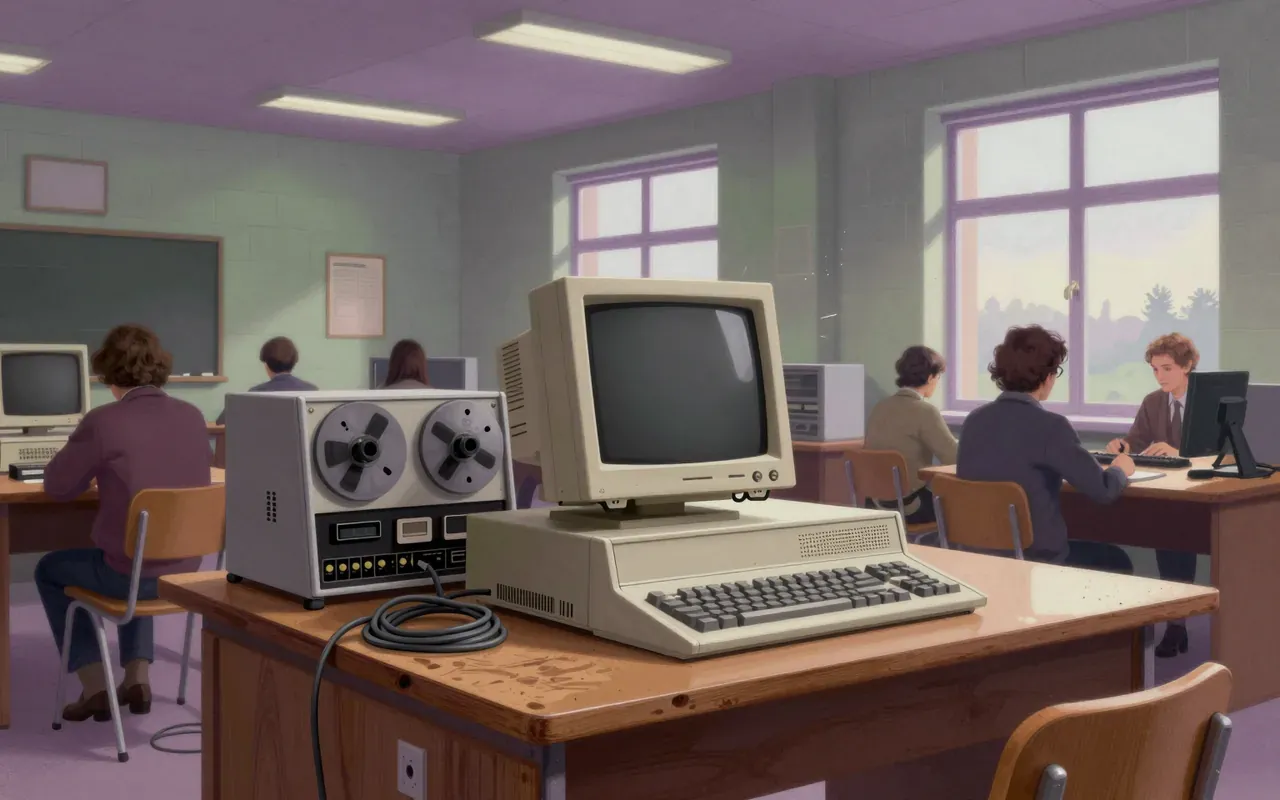
The BBC Micro wasn’t built for schools—it was built to win a contract, then retrofitted into classrooms by government cheque.
The BBC Micro was a procurement win first, an educational tool second. It succeeded because it met rigid broadcast and policy constraints—not because it was inherently superior to alternatives. Its architecture prioritised demonstrable compliance over user flexibility. Its dominance was guaranteed by subsidy rules, not market preference.
hardware designers studying spec-driven development
Skip it if
developers seeking modern platform insights
users evaluating contemporary classroom tools
investors assessing commercial scalability
The written brief1 min read
What it is and the problem it solves
A microcomputer built by Acorn to meet the BBC’s 1981 Computer Literacy Project specification. It solved the problem of delivering a capable, teachable machine to schools at scale—when the BBC’s first choice, the NewBrain, failed to materialise.
How it works
It used a 2 MHz MOS Technology 6502 CPU and high-speed Hitachi HM4816 DRAM to enable shared memory access between CPU and video without wait states. It incorporated the Tube interface to support a Z80 second processor for CP/M compatibility.
What works
Its speed, graphics, and memory architecture met and exceeded the BBC’s spec. Its Tube interface delivered CP/M compatibility without compromising native performance. Its timing—prototype built overnight, contract signed February 1981, launch December 1981—enabled it to anchor the BBC’s televised literacy campaign.
What does not
It did not deliver CP/M natively. It did not use the Z80 CPU the BBC originally expected. It did not ship with industry-standard software—its OS was proprietary.
What it changes
It shifted UK school computing from fragmented, underfunded experimentation to a centrally coordinated, government-subsidised standard—with the BBC Micro as one of only three approved models eligible for 50% cost support.
Is it worth your time
Yes—if you are assessing how state-backed procurement shapes hardware design, or how tightly coupled broadcast media and classroom tools can drive mass adoption in education.