technologybriefs
9:20in productionCh. 1 · A fork, not a foundation/ 9:20 · ceiling 15 min
Hardware · Tools

Arduino

Arduino didn’t democratise hardware — it outsourced the hard parts to hobbyists.

Arduino is a pedagogical tool repackaged as infrastructure. It delivers on accessibility — not scalability, safety, or sustainability.

Chapters & takeaways4
  1. 1:10
    A fork, not a foundation

    Arduino began as a pedagogical fork — not a clean-slate invention.

  2. 2:23
    How it talks to the world

    It works by exposing raw I/O pins and wrapping C/C++ in a Processing-like API.

  3. 4:06
    Open hardware, closed supply chain

    Boards ship commercially but remain open reference designs — hybrid distribution by design.

  4. 5:18
    Prototyping, not production

    It enables environment-interacting devices — but only at the prototype layer.

Worth your time?

Yes. Study the whole thing.

3.5/ 5
What works
  • low-cost prototyping
  • cross-disciplinary teaching
  • shield-based modularity
  • C/C++ accessibility
What does not
  • production-ready
  • secure
  • certifiable
  • memory-safe
Study it if
  • students
  • designers
  • hobbyists
Skip it if
  • industrial engineers
  • safety-critical developers
  • IoT product teams
The written brief1 min read

What it is and the problem it solves

Arduino is an open-source hardware and software platform created in 2005 to lower the barrier to physical computing. It solves the problem of inaccessible, expensive, and overly complex microcontroller development for non-specialists.

How it works

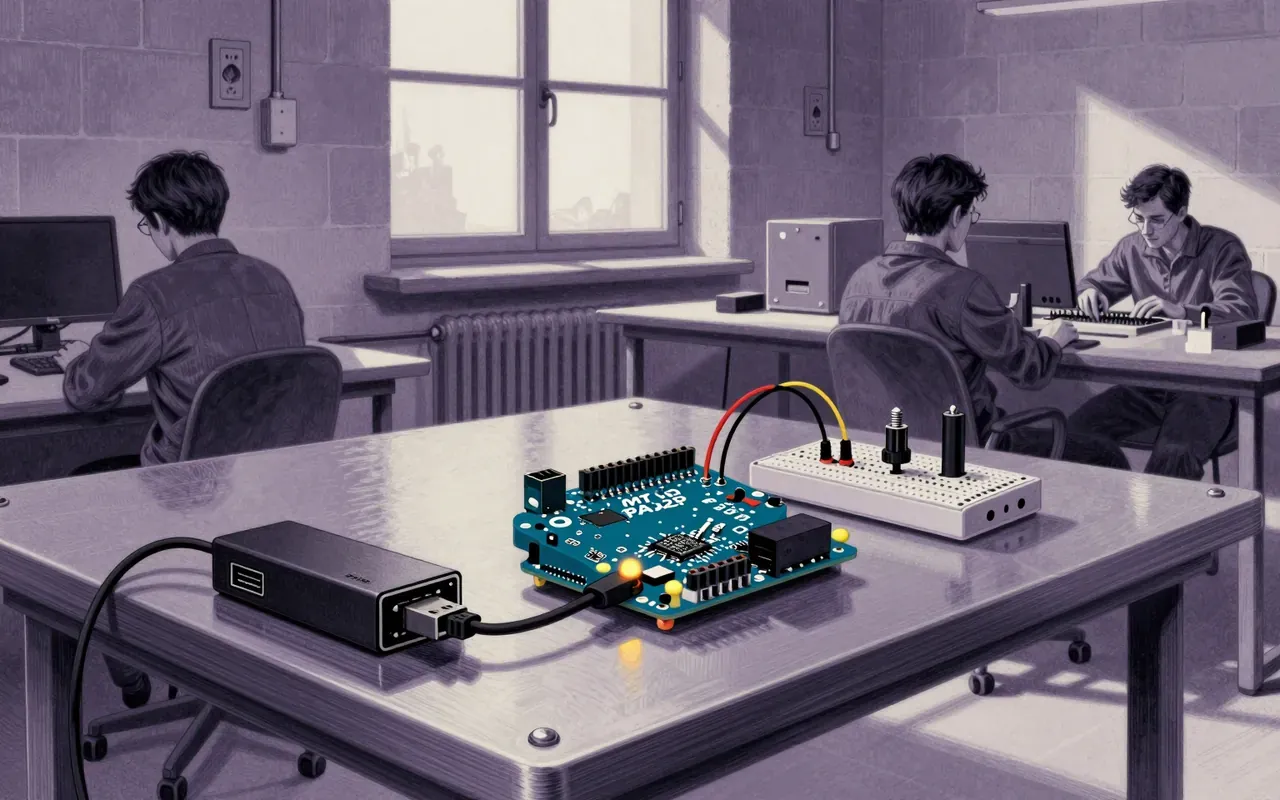
Arduino boards expose digital and analog I/O pins for connecting sensors, actuators, shields, and breadboards. They run C/C++ code via an API inspired by Processing. The hardware designs are open under CC BY-SA 2.5. Boards use a variety of microprocessors — starting with the ATmega8 — and are programmed using a modified Processing IDE.

What works

The fork from Wiring works: the ATmega8 support made boards cheaper and more widely distributable. The Processing-inspired API works for rapid iteration. The shield ecosystem works for modular expansion. Open licensing works for commercial and community distribution.

What does not

Arduino does not solve embedded systems engineering at scale. It offers no built-in abstraction for concurrency, memory safety, or hardware abstraction layers. Its IDE hides compiler toolchains and linker scripts, limiting debugging depth. It makes no provision for certification, security hardening, or long-term maintenance.

What it changes

It changes who can build interactive hardware: students, designers, artists, and tinkerers gain direct access to microcontroller I/O without EE training. It shifts prototyping from lab-bound oscilloscopes and JTAG debuggers to desktops with USB cables and breadboards.

Is it worth your time

Yes — if you need fast, low-cost physical prototyping without custom firmware or PCB design. No — if you require real-time guarantees, production-grade reliability, or power efficiency beyond hobbyist thresholds.

Same field · Hardware4 of 19
9:54
5G5G is a defined cellular standard—not a monolithic upgrade. Its real-world impact depends entirely on deployment mode, spectrum choice, and backhaul investment. It enables new use cases only where standalone architecture and mid-band spectrum converge. Elsewhere, it functions as a marketing label atop LTE infrastructure.
9:09
BluetoothBluetooth is a short-range wireless technology standard for exchanging data and building personal area networks. In the most widely used mode, Bluetooth has a range of up to 10 metres due to a 2.5 milliwatt transmission power limit. Bluetooth operates using UHF radio waves in the 2.402–2.48 GHz ISM bands. Bluetooth serves as a wireless alternative to wired connections for file exchange and audio device interconnection. The short-link radio technology that became Bluetooth was initiated in 1989 by Nils Rydbeck at Ericsson Mobile to develop wireless headsets. Principal design and development of Bluetooth began in 1994, yielding a workable solution by 1997. The first Bluetooth device, a hands-free mobile headset, was revealed in 1999 and won the 'Best of show Technology Award' at COMDEX. The Ericsson R520m, released in Quarter 1 of 2001, was the first commercially available Bluetooth phone. Bluetooth uses a radio technology called frequency-hopping spread spectrum. The specifications were formalized by the Bluetooth Special Interest Group (SIG) and formally announced on 20 May 1998. The Institute of Electrical and Electronics Engineers (IEEE) standardized Bluetooth as IEEE 802.15.1 but no longer maintains the standard.
10:33
Boston Dynamics1992Boston Dynamics builds legged robots that solve terrain traversal problems no wheeled system can handle. Its breakthroughs are mechanical—not cognitive. It delivers motion, not agency. Its value lies in proving dynamic locomotion is possible—not in deploying it widely.
10:01
Butler LampsonButler Lampson’s contribution is architectural rigour—not invention ex nihilo. He codified what a GUI computer must contain to function coherently: input, display, and system integration at human scale. That structure outlived the Alto.
Up next in Technology

ARPANET

1969 · 8:48

ARPANET wasn’t the internet—it was the first proof that a decentralised, packet-switched network could survive its own complexity.

8:48