technologybriefs
8:44in productionCh. 1 · What it is/ 8:44 · ceiling 15 min
Tech history · Hardware

Difference engine

A working mechanical computer built in 1822—except it wasn’t built until 1991, proving genius doesn’t guarantee delivery.

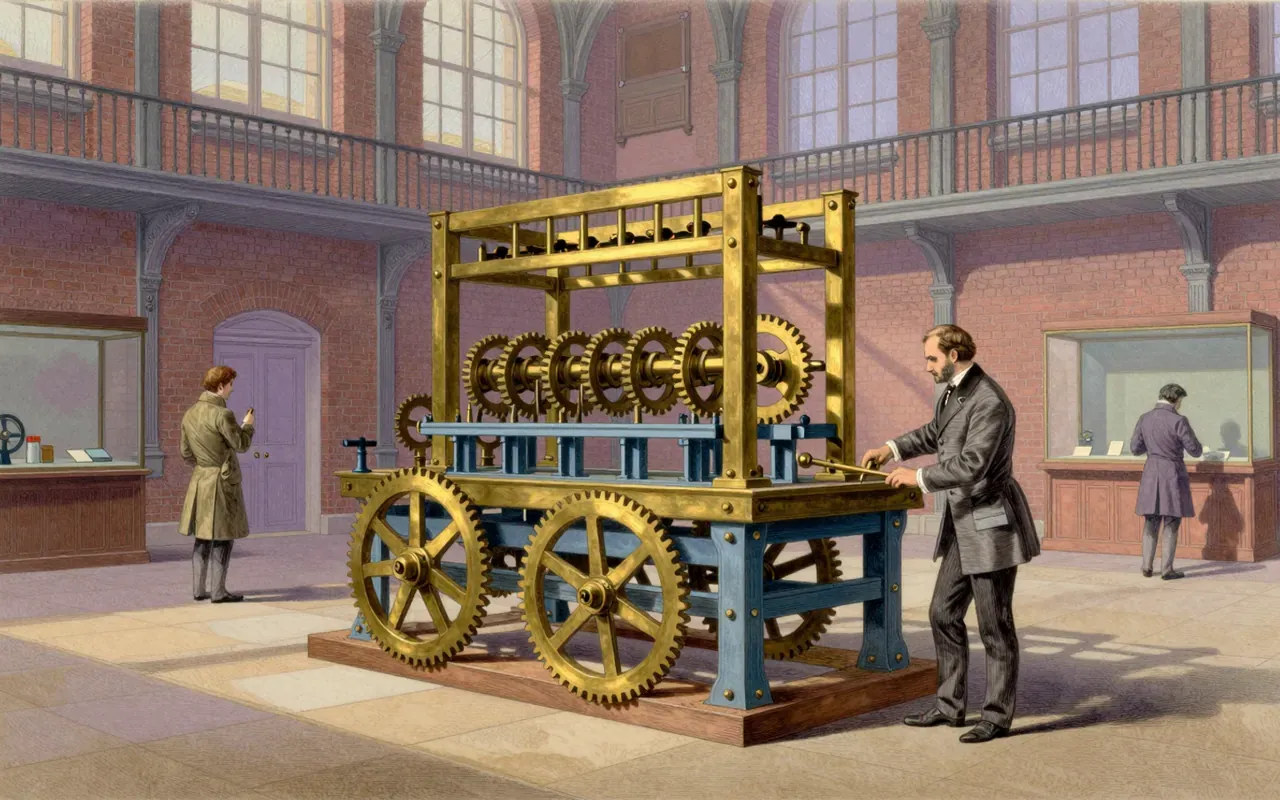
The difference engine is a proof that mechanical computation at high precision was possible in the 1820s—but only for one narrow class of problems, and only if built correctly. Its value lies not in what it delivered, but in what it demonstrated could be delivered.

Chapters & takeaways5
  1. 0:57
    What it is

    It is not a general-purpose computer—it is a single-function machine built to eliminate human error in printed mathematical tables.

  2. 2:02
    How it calculates

    It computes by repeated addition only—no multiplication, no division, no memory beyond its registers.

  3. 3:05
    What was feasible

    Its scale (8,000 parts, 5 tons) and precision (31 digits, 7th order) were achievable with Georgian-era tools.

  4. 4:30
    What was missing

    Minor design flaws were found and fixed during reconstruction—proof the original plan was functional, not fantasy.

  5. 5:38
    How it delivers results

    Its printer does not produce paper output—it makes moulds for mass printing, cutting typesetting out of the chain.

Worth your time?

Yes. Study the whole thing.

3.5/ 5
What works
  • tabulating 7th-degree polynomials to 31-digit precision
  • producing stereotype plates via plaster flongs
  • operating within 19th-century manufacturing tolerances
What does not
  • compute non-polynomial functions
  • store reusable intermediate values
  • correct input errors
  • support conditional logic
Study it if
  • historians of engineering
  • mechanical computation researchers
  • designers of error-resilient systems
Skip it if
  • software developers
  • AI practitioners
  • modern system architects
The written brief1 min read

What it is and the problem it solves

It is an automatic mechanical calculator designed to eliminate human error in mathematical tables. It solves the problem of transcription and typesetting mistakes in navigation, astronomy, and engineering tables.

How it works

It uses Newton’s method of divided differences to tabulate polynomial functions. It performs only addition and carry operations. It avoids multiplication and division entirely. Its name comes from the method of finite differences.

What works

The 1991 reconstruction works. It holds eight 31-digit numbers. It tabulates 7th-degree polynomials to 31-digit precision. Its printer produces plaster flongs for stereotype plates. Its 8,000-part, 5-ton mechanism operates within 19th-century manufacturing tolerances.

What does not

It does not compute non-polynomial functions. It does not store intermediate results for reuse beyond its fixed register set. It does not correct input errors. It has no conditional logic or branching. It was never completed in Babbage’s lifetime.

What it changes

It proves that automatic, high-precision, error-resistant polynomial tabulation was mechanically possible in the 1820s. It establishes that 19th-century tolerances were sufficient for complex calculating machinery. It shifts the benchmark for what constitutes a viable mechanical computer from theoretical sketch to buildable design.

Is it worth your time

Yes—if you work on mechanical computation, historical engineering feasibility, or error-resistant calculation systems. No—if you need real-time output, programmability, or integration with other systems. It is a proof, not a tool.

Same field · Tech history4 of 139
Up next in Technology

DVD

multiple vendors · 9:56

DVD didn’t unify media—it multiplied formats, then locked them behind lasers and licences.

9:56