technologybriefs
Topic

Mathematics

The language that keeps turning out to describe things it was not built for.

9
in technology
10:04
average
91 min
in total
79
across the network
Mathematics across the network →
All briefs9
10:41

Paper size

Deutsches Institut für Normung

ISO 216 is the international paper size standard. It originated as DIN 476 in Germany in 1922. It was adopted globally as ISO 216 in 1975. It uses a √2 aspect ratio. Each size halves the area of the next larger size. Tolerances are specified per dimension range. It governs usage everywhere except the US and Canada.


8:22

Closed-loop controller

Nicholas Minorsky

Closed-loop control uses feedback to regulate dynamical systems. It requires sensors, a controller, actuators, and a plant. It improves disturbance rejection, stability, and accuracy over open-loop methods—but depends entirely on correct implementation, sensor fidelity, and controller design. Nicholas Minorsky is not mentioned in the source material.

9:26

Zero-knowledge proof

Proof does not require disclosure—this idea was mathematically proven in 1985, not invented by blockchain.
12:36

RSA cryptosystem

Ron Rivest, Adi Shamir and Leonard Adleman · 1977

RSA is the first publicly described, usable public-key cryptosystem. It works by exploiting the asymmetry between modular exponentiation and root extraction modulo a composite number whose factorisation is secret. Its security depends on factoring difficulty—but that dependence is not proven equivalent. No published attack breaks it with large keys. It changed cryptography by enabling open protocols, trustless key exchange, and standardised role names like Alice and Bob.

8:44

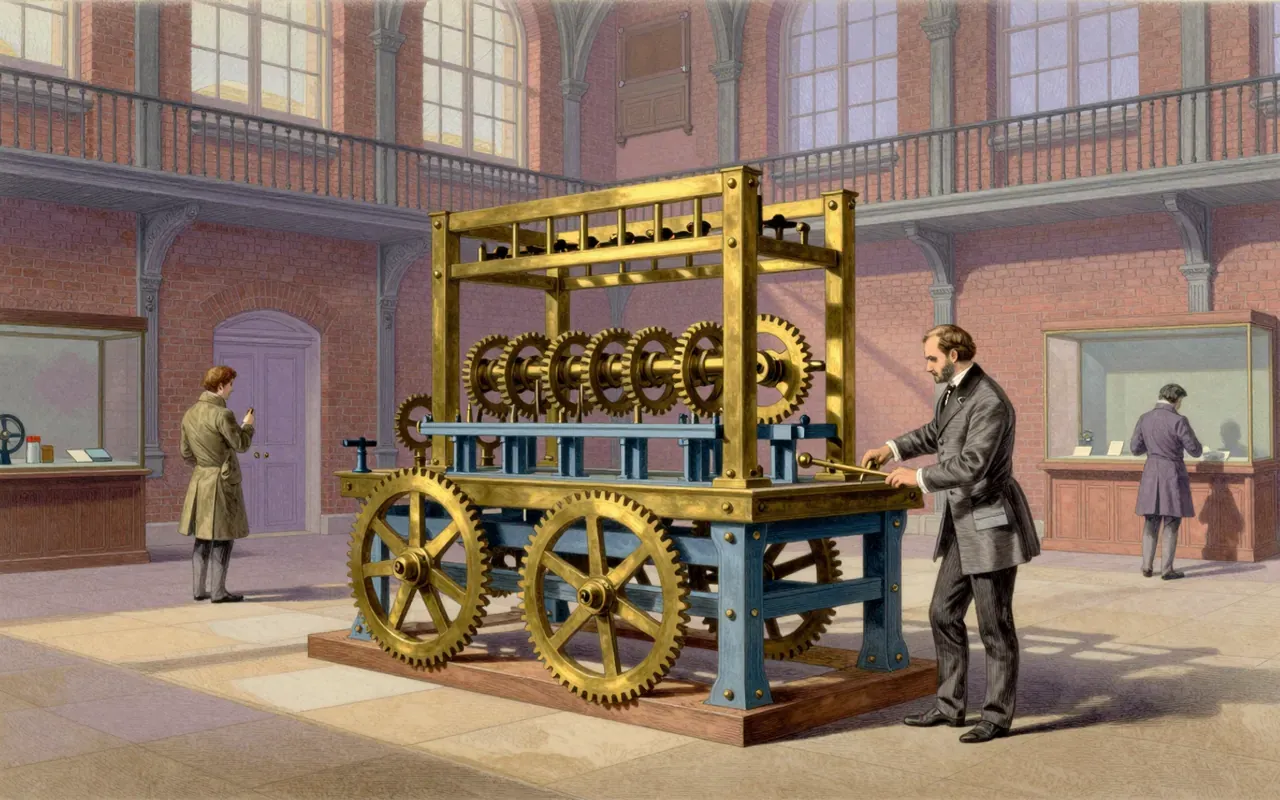
Difference engine

Charles Babbage · 1822

The difference engine is a proof that mechanical computation at high precision was possible in the 1820s—but only for one narrow class of problems, and only if built correctly. Its value lies not in what it delivered, but in what it demonstrated could be delivered.

10:46

Elliptic-curve cryptography

Victor S. Miller and Neal Koblitz

ECC is a public-key method based on elliptic curves over finite fields. Proposed independently by Koblitz and Miller in 1985. Delivers equivalent security to RSA and ElGamal with smaller keys. Security rests on the hardness of the elliptic curve discrete logarithm problem — specifically, recovering scalar k from points P and Q = kP — and on efficient yet irreversible point multiplication for appropriate parameters.

10:04

Manchester Mark 1

It proved arrays could be traversed without self-modifying code—and then shipped that idea to industry before it had a compiler.