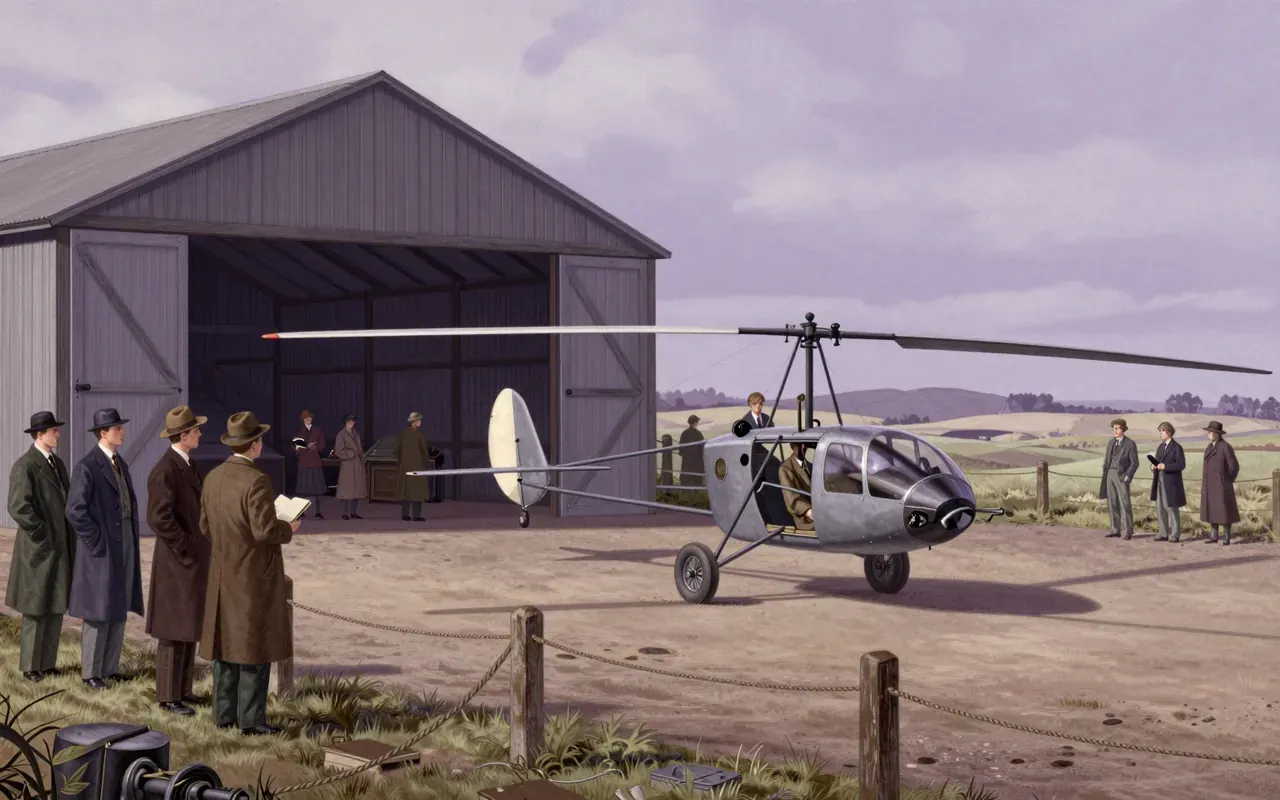
De la Cierva didn’t invent the helicopter rotor—he invented the autogyro’s hinge, and helicopters borrowed it.
The articulated rotor solved dissymmetry of lift in autogyros using mechanical hinges—not powered rotation. It enabled stable forward flight and jump take-off, but did not enable hovering or VTOL. Its influence on helicopters is real but indirect: it provided the hinge architecture, not the propulsion model.
The autogyro was invented in 1920; dissymmetry of lift caused fatal roll instability until the 1923 flapping hinge.
2:08
The mechanism: three degrees of freedom
Each blade moves independently via hinges—flapping up/down, dragging fore/aft, feathering to change pitch.
3:54
The proof: flight without powered rotation
Autorotation—not engine drive—generates lift. Stability was proven at Farnborough in 1925; jump take-off followed in the C.40.
5:42
The legacy: borrowed, not built
This was never a helicopter system—but its hinge geometry became the basis for successful helicopter development later.
Worth your time?
Yes. Study the whole thing.
4/ 5
What works
Resolves dissymmetry of lift
Enables stable autorotative flight
Supports jump take-off in production models
What does not
Enable hover
Provide powered lift
Eliminate forward-speed dependency
Study it if
Rotary-wing designers
Aviation historians
Flight dynamics engineers
Skip it if
Helicopter pilots
Urban air mobility planners
Electric VTOL developers
The written brief1 min read
What it is and the problem it solves
It is an articulated rotor for the autogyro, invented to solve uncontrolled rolling during take-off attempts.
How it works
Each rotor blade attaches to the hub via hinges that allow independent flapping, dragging and feathering motion. This lets blades adjust pitch and position in real time during rotation.
What works
The flapping hinge resolves dissymmetry of lift. The C.4 flew stably in 1923. The 1925 Farnborough demonstration succeeded. The C.40 achieved jump take-off in production.
What does not
It does not power vertical take-off or hover. It relies on forward motion to sustain autorotation. It is not a helicopter rotor by design or function.
What it changes
It enables stable rotary-wing flight at speed by solving dissymmetry of lift—the unbalanced rolling caused by differing airspeeds across the rotor disc.
Is it worth your time
Yes—if you work on rotary-wing systems, flight control theory, or early aviation mechanics. It is foundational hardware, not a finished helicopter solution.