technologybriefs
Saved
Hardware · Tech history

Particle accelerator

Particle accelerators don’t reveal 'the building blocks of reality' — they reveal what happens when you smash protons hard enough to break known rules.

Worth your time?4/5Yes.Study the whole thing.What works, what does not, who it is for ↓
9:54in productionCh. 1 · How it moves particles/ 9:54 · ceiling 15 min
4 chapters · 9:54Ceiling 15:00

The brief is written and checked. The video joins this page when it is cut.4 chapters · 1 min read · 9:54 planned

Read the brief

Particle accelerators are precision electromagnetic machines — not philosophical instruments. They work reliably at defined scales, but their energy, cost, and infrastructure demands confine them to specialist applications. Their value lies in reproducible engineering, not speculative unification.

Chapters & takeaways4
  1. 1:02
    How it moves particles

    It accelerates ions using electromagnetic fields — electrostatic or electrodynamic — not magic, not brute force, but controlled field geometry.

  2. 2:48
    First working circular machines

    The cyclotron (1929) and betatron (1940) proved circular acceleration was possible — but only for specific particles and energy ranges.

  3. 4:33
    The scale ceiling

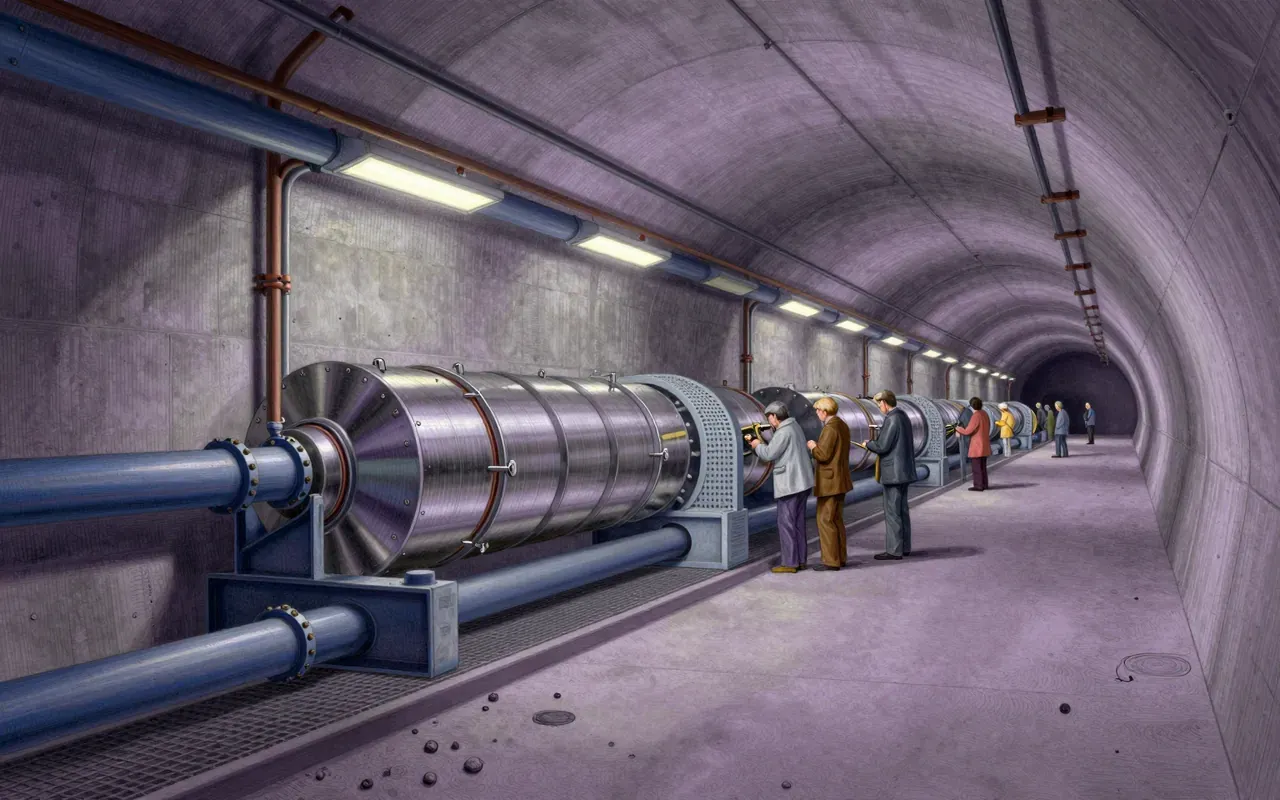
    The LHC is the largest and highest-energy accelerator for elementary particle physics — but its 13 TeV collisions still fall short of Planck-scale energies by fifteen orders of magnitude.

  4. 6:24
    Where they actually live

    Over 30,000 accelerators run today — most are small, fixed-energy devices in hospitals and factories, not giant colliders.

Worth your time?

Yes. Study the whole thing.

4/ 5
What works
  • resolving subatomic structure
  • producing medical radioisotopes
  • doping semiconductors
  • treating deep tumours with proton beams
What does not
  • deliver practical fusion energy
  • enable tabletop quantum gravity experiments
  • replace conventional radiotherapy in low-resource settings
Study it if
  • medical physicists
  • materials scientists
  • nuclear engineers
Skip it if
  • software developers
  • policy analysts
  • AI researchers
The written brief1 min read

What it is and the problem it solves

A particle accelerator is a machine that propels ions using electromagnetic fields. It solves the problem of observing structures smaller than atoms by giving particles enough energy to resolve them or trigger detectable reactions.

How it works

It uses electromagnetic fields to propel ions to high speeds and energies, containing them in well-defined beams. Electrostatic types use static electric fields. Electrodynamic types use changing electromagnetic fields — either magnetic induction or oscillating radio frequency fields.

What works

Cyclotrons (invented 1929) reliably accelerate protons for medical isotope production. Betatrons (invented 1940) accelerate electrons via magnetic induction. The LHC (operational since 2009) collides two 6.5 TeV proton beams to achieve 13 TeV center-of-mass energy. Over 30,000 accelerators operate worldwide — most in hospitals and factories, not physics labs.

What does not

It does not produce net energy. It does not accelerate all particle types equally well. It does not eliminate background radiation in detectors. It does not make elementary particle physics experimentally accessible outside large national or multinational facilities.

What it changes

It changes how we probe matter at subatomic scales. It changes industrial quality control through non-destructive imaging. It changes cancer treatment via proton beam therapy. It changes radioisotope production for diagnostics.

Is it worth your time

Yes — if your work involves nuclear medicine, materials analysis, semiconductor doping, or fundamental physics. No — if you expect a single device to unify quantum mechanics and gravity, or deliver practical energy generation.

Same field · Hardware4 of 251
8:44
CentrifugeThe centrifuge is a mechanical device that uses centrifugal force to separate mixtures by density. It works by spinning samples at high speed, forcing denser components outward and lighter ones inward. It delivers consistent, scalable separation—from dairy cream to nano-scale particles—but only where density differences exist. It changes how we isolate biological, industrial, and chemical components, replacing time-dependent settling with controlled acceleration. Its limits are physical, not computational: no intelligence, no adaptation, no chemistry—just rotation and consequence.
10:45
Photomultiplier tubeThe photomultiplier tube is a vacuum-based electron amplifier that converts photons into measurable current via cascaded secondary emission. It solved low-light detection before solid-state alternatives existed—but required precise vacuum engineering, magnetic shielding, and cathode material science to function. Its two independent 1934 demonstrations—one at RCA, one in the USSR—show how tightly coupled theory, materials, and infrastructure were in pre-transistor electronics.
9:52
X-ray tubeThe X-ray tube is a hardware foundation for radiography. Its innovation was deterministic, electrically gated X-ray production — not discovery of X-rays themselves. It trades massive inefficiency (99% heat) for precise, repeatable control. That trade still defines every medical and industrial X-ray system today.
10:20
Optical fiberOptical fiber is a light-guiding medium based on total internal reflection. Its utility emerged slowly: foundational principle shown in the 1840s; waveguiding mechanism defined in 1870; image transmission proven in 1953; first clinical device patented in 1956. It replaces electrical cables only where low loss and EMI immunity matter—not everywhere, not automatically, not immediately.
Up next in Technology

PH meter

Arnold Beckman · 9:38

It didn’t measure pH better — it made pH measurable where it wasn’t before.

9:38