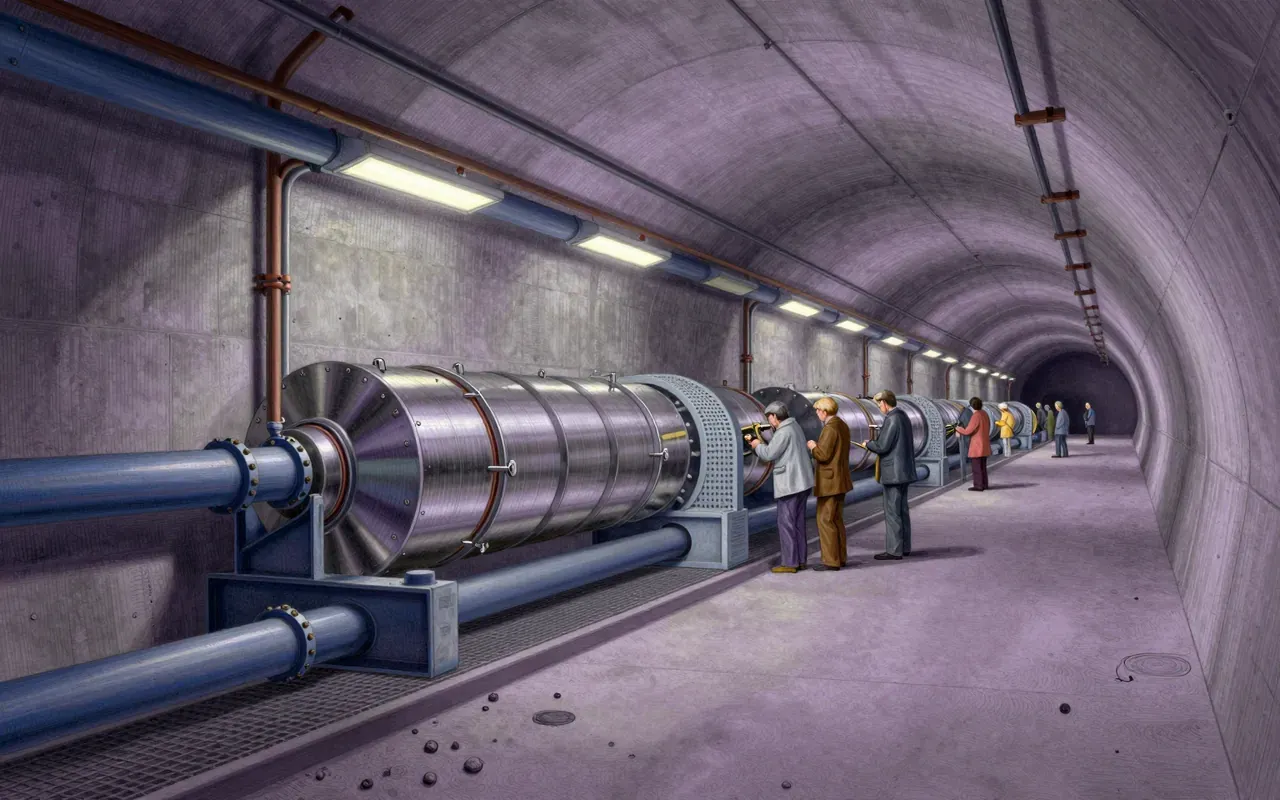
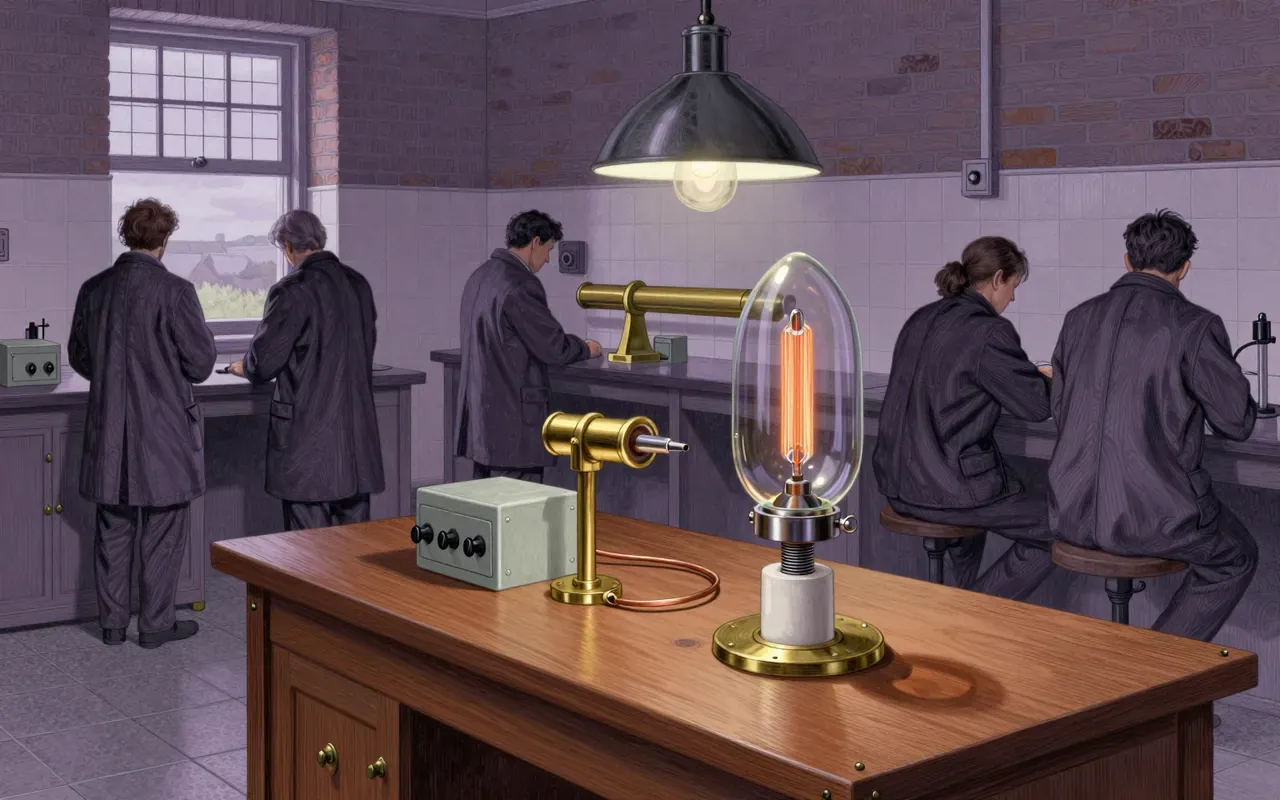
The photomultiplier tube is a vacuum-based electron amplifier that converts photons into measurable current via cascaded secondary emission. It solved low-light detection before solid-state alternatives existed—but required precise vacuum engineering, magnetic shielding, and cathode material science to function. Its two independent 1934 demonstrations—one at RCA, one in the USSR—show how tightly coupled theory, materials, and infrastructure were in pre-transistor electronics.
The first photomultiplier was built in early 1934 by Iams and Salzberg at RCA—not as a prototype, but as a fully characterised device submitted to Proc. IRE before June.
2:52
Geometry defines gain and speed
Its geometry—a semi-cylindrical photocathode, axial secondary emitter, and surrounding collector grid—enabled gain of ~8× and bandwidth above 10 kHz.
4:33
Soviet design leapfrogged RCA
Kubetsky proposed the multiple-dynode design in 1930 and built it in 1934—achieving ≥1000× gain six months before Zworykin saw it in September.
5:56
Two labs, one breakthrough
RCA equipment imports and Soviet vacuum tube research created parallel development paths—Zworykin saw Kubetsky’s device during a visit enabled by that infrastructure.
1 more chapterFewer chapters
Worth your time?
Yes. Study the whole thing.
4.5/ 5
What works
Iams and Salzberg’s 1934 design achieves ~8× gain and operates above 10 kHz
Kubetsky’s 1934 multiple-dynode version achieves ≥1000× gain
What does not
scale to mass production without precision vacuum engineering
operate in ambient light or magnetic fields without shielding
deliver stable gain over time without cathode ageing compensation
Study it if
physicists measuring scintillation events
engineers designing radiation detectors
historians of vacuum electronics
Skip it if
software developers
AI model trainers
cloud infrastructure teams
Who should study it, and who should skipHide who it is for
The written brief1 min read
What it is and the problem it solves
A vacuum tube that detects and amplifies faint light. It solves the problem of measuring extremely low-intensity optical signals—too weak for direct electronic amplification in the 1930s.
How it works
It combines the photoelectric effect and secondary emission in a vacuum tube. Light strikes a photocathode, releasing electrons. Those electrons hit a secondary emitter, releasing more electrons. This cascade repeats across dynodes to amplify the signal.
What works
Iams and Salzberg’s 1934 design works: semi-cylindrical photocathode, axial secondary emitter, collector grid. It achieves ~8× gain and operates above 10 kHz. Kubetsky’s 1934 multiple-dynode version works: ≥1000× gain using magnetic confinement and Ag-O-Cs photocathode.
What does not
It does not scale to mass production without precision vacuum engineering. It does not operate in ambient light or magnetic fields without shielding. It does not deliver stable gain over time without cathode ageing compensation.
What it changes
It changes single-photon detection from theoretical to practical. It enables real-time amplification of weak optical signals before electronic amplifiers existed. It establishes vacuum electron multiplication as a viable architecture for signal gain.
Is it worth your time
Yes—if you work with low-light detection in physics, nuclear instrumentation, or early television systems. Its gain, bandwidth, and vacuum constraints define its operational envelope—and its obsolescence in most modern applications.