technologybriefs
9:41in productionCh. 1 · The Point Rule/ 9:41 · ceiling 15 min
Hardware · Tech history

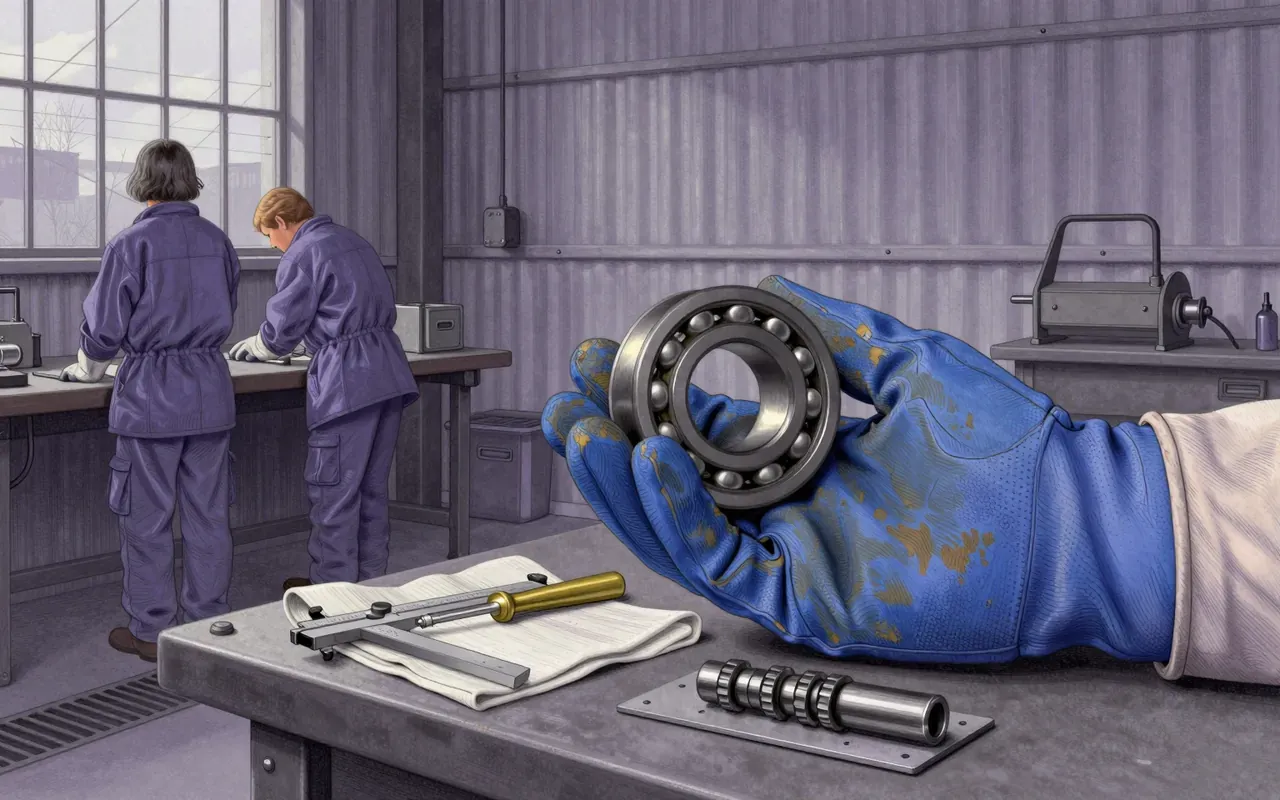
Tapered roller bearing

It doesn’t balance loads—it projects them, precisely, to a point no one can see.

Tapered roller bearings solve compound-load support by projecting geometry to a point—not by adding parts or complexity. They deliver real advantages in load capacity and wear resistance, but only when applied with discipline. Their 1895 invention remains relevant because the physics has not changed—and neither has the cost of getting the cone angle wrong.

Chapters & takeaways4
  1. 1:14
    The Point Rule

    All surfaces meet at one point—so motion stays coaxial and sliding vanishes.

  2. 2:30
    No Scrub, More Load

    Linear contact carries more load; matched tangential speeds stop scrubbing.

  3. 3:58
    Flange and Angle

    The inner flange pins rollers in place—and cone angle sets axial capacity.

  4. 5:51
    Two Parts, One Function

    Cone assembly and cup separate for mounting—but not for operation.

Worth your time?

Yes. Study the whole thing.

4.5/ 5
What works
  • coaxial motion
  • linear contact
  • flange restraint
  • separability
What does not
  • self-align
  • reduce radial capacity when axial demand rises
  • eliminate need for preload adjustment
  • operate without precise mounting
Study it if
  • mechanical designers
  • maintenance engineers
  • rotating-equipment specifiers
Skip it if
  • software developers
  • AI researchers
  • UI designers
The written brief1 min read

What it is and the problem it solves

A mechanical bearing that solves the problem of supporting simultaneous axial and radial forces without sliding wear or roller dislodgement. It replaces compromise solutions like paired angular contact ball bearings or thrust + radial combinations.

How it works

Tapered roller bearings use conical raceways and tapered rollers whose axes project to a single point on the bearing’s main axis. This geometry ensures coaxial motion, eliminates sliding between roller and raceway, and equalises tangential speeds along the entire contact patch.

What works

The linear contact patch carries higher loads than ball bearings. The inner-ring flange prevents roller ejection under axial force. Coaxial projection and matched tangential speeds eliminate scrubbing. Axial capacity scales predictably with cone angle. Separability allows independent mounting and inspection.

What does not

It does not eliminate all friction—only differential scrubbing. It does not self-align. It does not simplify assembly: separability requires careful preload adjustment during mounting. It does not scale linearly with size—the cone angle must be chosen per application, and larger angles reduce radial capacity.

What it changes

It changes how engineers distribute load paths in gearboxes, wheel hubs, and industrial drives. It enables predictable, serviceable support of compound loads where ball or cylindrical bearings would fail prematurely.

Is it worth your time

Yes—if you are specifying or maintaining rotating equipment that carries combined axial and radial loads. It is not a general-purpose replacement for ball bearings; its value lies in precise mechanical integration, not versatility.

Same field · Hardware4 of 111
Up next in Technology

Rotary printing press

Richard March Hoe · 9:58

Rotary printing did not invent speed—it re-engineered motion to make newspapers disposable.

9:58