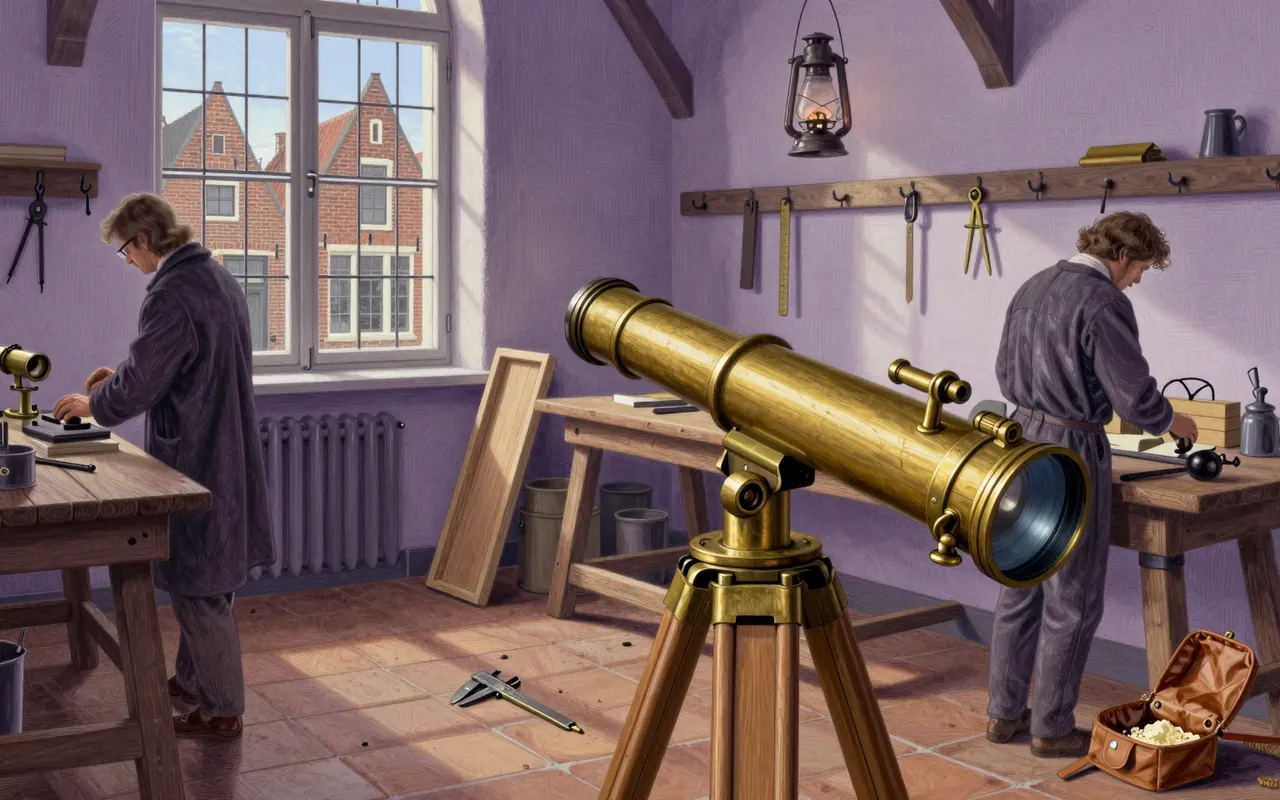
The Lippershey telescope is not the origin of astronomy—it is the origin of optical procurement. It works. It is limited. It was copied before it was patented. Its legacy is procedural, not optical.
Lippershey filed the first known written record of a refracting telescope on 2 October 1608 in the Netherlands.
2:38
Upright, Not Inverted
Its convex objective and concave eyepiece produced an upright image—unlike later astronomical telescopes.
4:28
Three Times, Not Thirty
It delivered exactly 3× magnification—enough for harbour watch, not for star charts.
6:36
Funded Without Protection
No patent. But a government contract—making it the first publicly funded optical instrument programme.
1 more chapterFewer chapters
Worth your time?
Yes. Study the whole thing.
3.5/ 5
What works
delivers upright image
enables terrestrial surveillance at range
triggers formal state commissioning of optical devices
establishes refracting telescope as a documented, reproducible artefact
What does not
achieve more than 3× magnification
invert the image
enable celestial observation beyond basic lunar features
receive patent protection
Study it if
historians of science
optical engineers studying early lens configurations
policy researchers examining state adoption of dual-use technology
Skip it if
astronomers seeking observational capability
inventors looking for novel optical principles
educators using it as a model of scientific breakthrough
Who should study it, and who should skipHide who it is for
The written brief1 min read
What it is and the problem it solves
It is a refracting telescope that solves the problem of observing distant terrestrial objects with clarity, not celestial ones.
How it works
It uses a convex objective lens and a concave eyepiece lens to bend light and produce an upright image.
What works
The convex-concave lens pairing delivers 3× magnification and an upright image—usable for navigation, surveying, and military spotting.
What does not
It does not invert the image—but that comes at the cost of limited magnification and field of view.
What it changes
It changes how optical instruments are treated as state assets: denied a patent, yet commissioned for replication by the Dutch government within weeks.
Is it worth your time
Yes—if you work in optics, patent history, or early modern science. Its mechanism is simple; its administrative impact was immediate and concrete.