What it is and the problem it solves
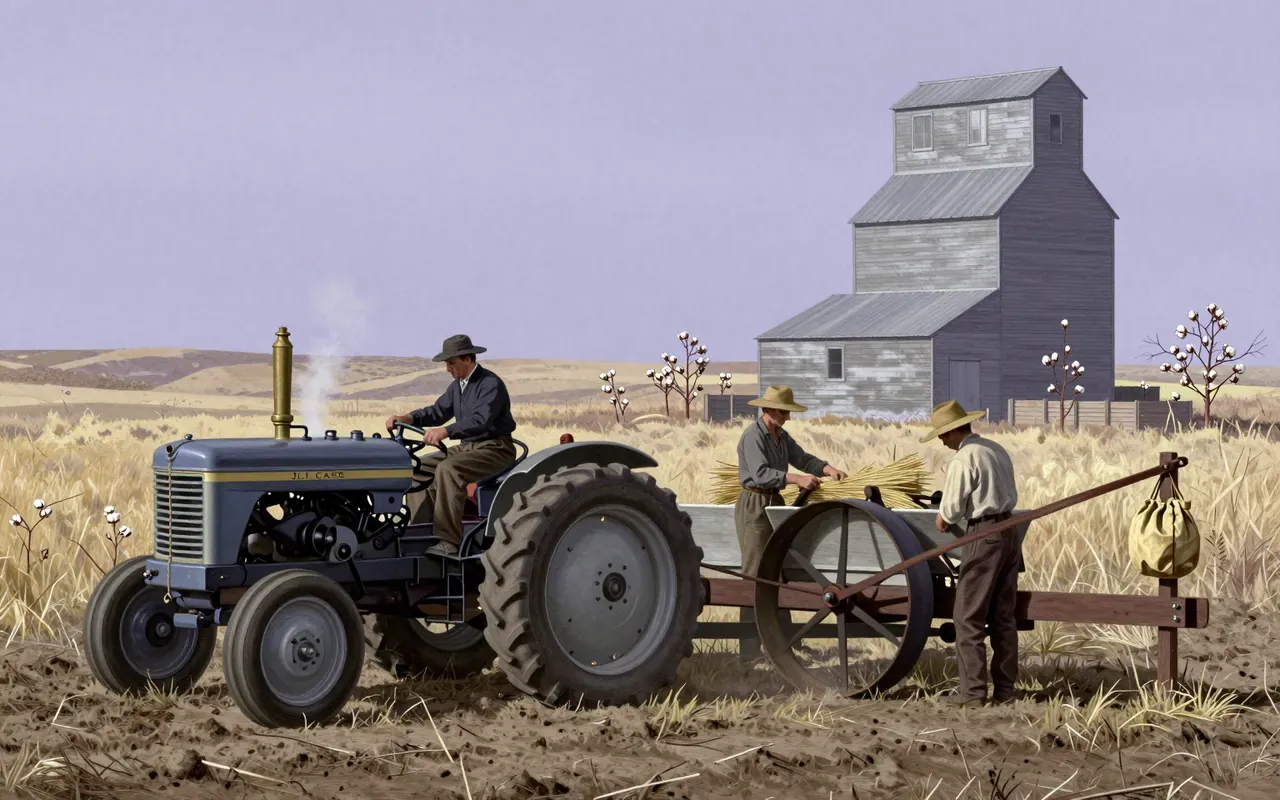
A self-propelled, gasoline-powered threshing rig. It solves coal scarcity for mobile threshing on the Great Plains.
John Froelich (1849–1933) ran a threshing business that travelled Iowa and South Dakota with steam-powered threshers. According to his biography, he failed to obtain coal for his steam engine, and in 1892 he and his blacksmith, Will Mann, built the tractor. It describes the result as the first mechanically successful gasoline-powered tractor with backward and forward propulsion. Another source credits the first gasoline tractors to John Charter in Illinois in 1889, who combined single-cylinder Otto engines with a Rumley steam engine chassis.
How it works
It mounts a Van Duzen single-cylinder gasoline engine on a Robinson engine chassis. Froelich’s custom gear box provides forward and reverse propulsion.
The machine was built in Clayton County, Iowa, and could be controlled and propelled through Froelich’s own gearing. Early tractors generally drove threshing machines and other stationary equipment through a belt or cable wrapped round the flywheel or a belt pulley. In most cases that arrangement required the tractor to remain in one location, with the work brought to it.
What works
It delivers forward and reverse motion. It powers a J.I. Case threshing machine for 52 days, threshing 72,000 bushels in Langford, South Dakota.
Froelich and Mann took the tractor to Langford, South Dakota, and connected it to the threshing machine there.
What does not
It does not scale. It does not survive beyond field testing. It does not sustain a business: the Waterloo Gasoline Engine Company collapsed by 1895.
The biography gives the sequence in more detail. In 1893 Froelich and a group of investors founded the Waterloo Gasoline Traction Engine Company in Waterloo, Iowa. It produced only four tractors and sold two, and both were returned as unsatisfactory. In 1895 the company abandoned tractor manufacturing and changed its name to Waterloo Gasoline Engine Company, making stationary engines instead. The tractor article puts it more bluntly: after receiving a patent Froelich invested all his assets, the venture was very unsuccessful, and by 1895 all was lost.
What it changes
It proves gasoline traction is mechanically possible in agriculture — but only as a one-off prototype, not as an adopted system.
Steam had set the pattern before it. The first tractors were steam-powered plowing engines used in pairs on either side of a field, hauling a plow back and forth with a wire cable, and steam-powered agricultural engines stayed in use well into the 20th century until reliable internal combustion engines had been developed. Froelich left the company in 1895 and died in St. Paul in 1933 in relative obscurity. His biography adds that Waterloo became a centre of internal combustion engine production in the early 20th century, and the town of Froelich commemorated the invention in 1939 and later opened a tractor museum where he assembled his first machine.
Is it worth your time
No — it failed commercially by 1895, left no working lineage, and offered no operational advantage over steam threshers beyond eliminating coal dependency.