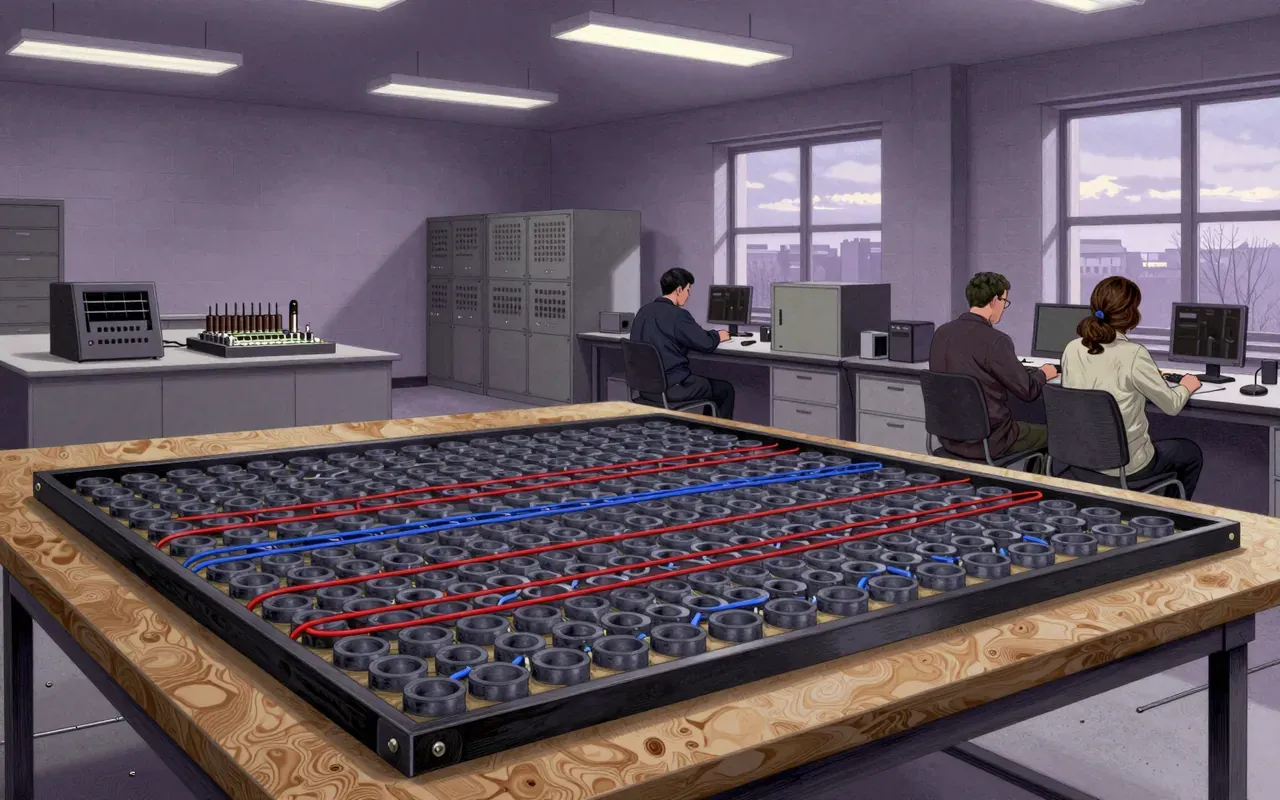
What it is and the problem it solves
Magnetic-core memory is a non-volatile RAM built from hand-threaded ferrite rings. It solves the problem of reliable, random-access, power-loss-resilient memory for early digital computers — before semiconductor memory existed.
How it works
Magnetic-core memory stores one bit per ferrite toroid. Cores sit in an X-Y-wired grid. Writing selects a single core by applying half-current to one X and one Y wire — only their intersection receives full threshold current. Magnetisation direction (clockwise or counterclockwise) encodes 1 or 0. Reading flips the field to detect state via induced pulse in a separate sense wire. That flip erases the bit, so rewrite circuitry must restore it immediately.
What works
Coincident-current selection reliably isolates single cores in dense arrays. The square hysteresis loop of semi-hard ferrite ensures stable bistable states. Destructive readout + immediate rewrite delivers consistent bit integrity. Sense-wire detection gives unambiguous 1/0 discrimination without amplification drift.
What does not
It does not scale beyond ~100 kilobytes without prohibitive wiring complexity. It cannot retain state during power loss without persistent magnetisation — but that same persistence makes rewriting slow and energy-intensive. It offers no byte-addressable abstraction: every access is discrete, physical, and timing-critical.
What it changes
It replaces delay-line and Williams tube memory with deterministic, non-volatile, random-access storage. It enables real-time control systems like Whirlwind — where microseconds matter and crashes are fatal. It establishes the first widely adopted memory architecture that decouples storage from vacuum-tube fragility.
Is it worth your time
Yes — if you work on memory systems, hardware archaeology, or low-level reliability trade-offs. Its destructive readout, physical wiring constraints, and manual assembly make it irrelevant for modern computing, but its design reveals how early engineers enforced determinism without transistors.