What it is and the problem it solves
A thread-based fabric-sewing device invented during the first Industrial Revolution to reduce manual labor in clothing production.
The sewing-machine article itself calls Thomas Saint’s 1790 design “generally considered” the first sewing machine, and sets it after an earlier British patent: in 1755 Charles Fredrick Wiesenthal, a German-born engineer working in England, was awarded the first British patent for a mechanical device to aid sewing, a double-pointed needle with an eye at one end. Saint’s machine was meant for leather and canvas, such as the soles of shoes, and for goods like saddles and bridles; it was also said to be capable of sewing ship sails.
How it works
It sews fabric and materials together with thread. Thomas Saint’s 1790 machine used the chain stitch method, relying on a single thread to form simple stitches.
A stitching awl would have pierced the material, and a forked-point rod would have carried the thread through the hole, where it would have been hooked underneath and moved to the next stitching place. The cycle would then repeat, locking the stitch in place. Saint was a skilled cabinet maker, and the design included an overhanging arm, a feed mechanism adequate for short lengths of leather, a vertical needle bar and a looper.
What works
The chain stitch method works mechanically: a single thread forms interlocking loops. But Saint’s version shows no proof of successful execution or durability.
Saint designed the machine but did not construct it, and probably never built a prototype. In 1874 William Newton Wilson, a sewing machine manufacturer, found Saint’s drawings in the UK Patent Office, made adjustments to the looper and built a working machine, which the Science Museum in London now owns. The design was very advanced for its era, but the concept needed steady improvement over the following decades before it was practical enough for wide use.
What does not
It does not establish a functional, scalable solution for clothing manufacturing. It lacks evidence of operation, adoption, or impact beyond its conceptual design.
Other early machines followed. In 1804 Thomas Stone and James Henderson built one, and John Duncan in Scotland constructed an embroidering machine. The Austrian tailor Josef Madersperger presented his first working machine publicly in 1814 and kept developing it until 1839, with government financial support.
What it changes
Nothing measurable in 1790. The real industrial shift began with Thimonnier’s 1829 machine — the first practical and widely used sewing machine.
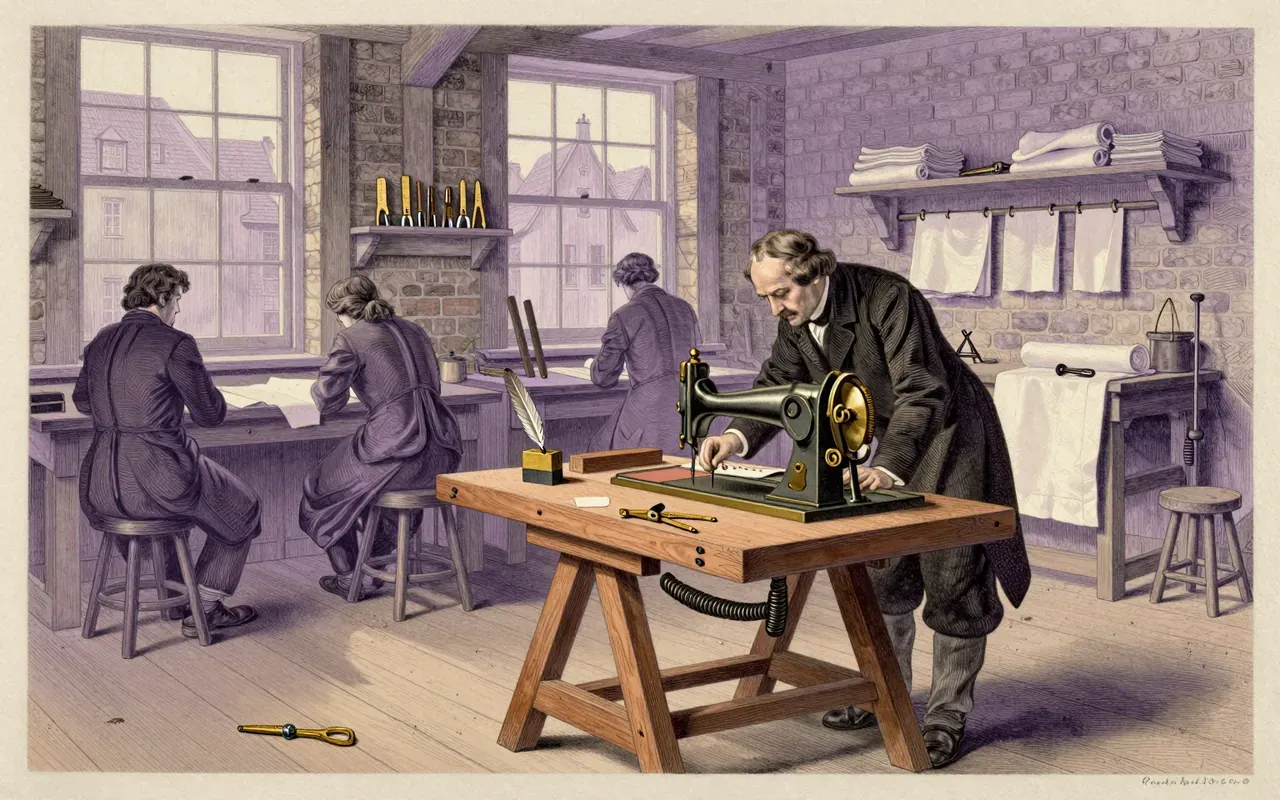
Thimonnier was a French tailor, and his machine sewed straight seams with a chain stitch like Saint’s model. Its patent was issued on 17 July 1830, and the same year he and his partners opened the first machine-based clothing manufacturing company in the world, making army uniforms for the French Army. The factory was burned down, reportedly by workers fearful of losing their livelihood. Later machines used other mechanisms: Walter Hunt’s American lockstitch machine of 1832, then Elias Howe’s in 1845 and Isaac Merritt Singer’s patented in 1851. Once machines reached consumers in the 1860s, one could produce a man’s shirt in about an hour, against 14 and a half hours by hand.
Is it worth your time
No — Saint’s 1790 machine was not practical, widely used, or commercially adopted. It solved no immediate production problem for clothing companies.