What it is and the problem it solves
An electromechanical device that solves the problem of converting continuous mechanical motion into usable electrical energy.
Before the link between magnetism and electricity was found, electrostatic generators used moving charged belts, plates and disks to carry charge to a high-potential electrode. They gave very high voltage at low current, were inefficient and hard to insulate, and so had low power ratings. They were never used for commercially significant quantities of power, and their only practical uses were to power early X-ray tubes and, later, some atomic particle accelerators.
How it works
It converts mechanical rotation into electrical current using Faraday’s law of induction: a conductor moving through a magnetic field generates electromotive force.
Mechanically, a generator has a rotor, the rotating part, and a stator, the stationary part that surrounds it. One produces a magnetic field and the other carries a wire winding in which the changing field induces current. The field comes either from wire field coils or from permanent magnets, and the winding that delivers power to the external circuit is called the armature. Electromagnetic generators fall into two broad categories: dynamos, which use a commutator to produce pulsing direct current, and alternators, which produce alternating current. A coil rotating in a magnetic field produces a current that changes direction every 180 degrees of rotation. In the first practical generators, the commutator, a set of rotating switch contacts on the armature shaft, reversed the winding’s connection every half turn to give pulsing DC. Sources of mechanical power include steam, gas and water turbines, internal combustion engines, wind turbines and even hand cranks.
What works
Multi-turn coil designs overcome the Faraday disk’s limitations, scaling voltage predictably and making generators industrially viable — as proven by the 1844 Woolrich generator.
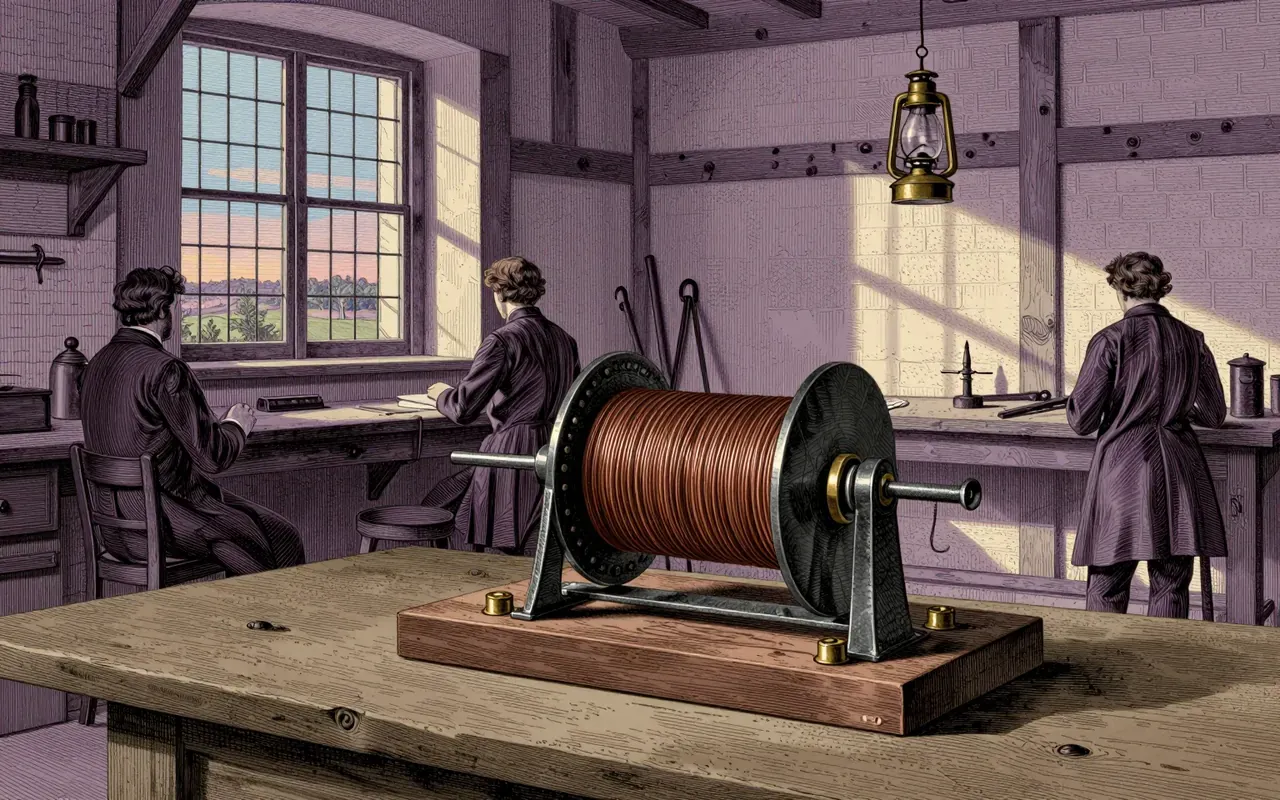
The Woolrich generator of 1844, now in Thinktank, Birmingham Science Museum, is described as the earliest electrical generator used in an industrial process: the firm of Elkingtons used it for commercial electroplating. One of the first dynamos had been built by Hippolyte Pixii in 1832. The modern industrial dynamo was invented independently by Charles Wheatstone, Werner von Siemens and Samuel Alfred Varley. Varley patented his on 24 December 1866, and Siemens and Wheatstone both announced theirs at the Royal Society on 17 January 1867. Their “dynamo-electric machine” used self-powering electromagnetic field coils instead of permanent magnets, which greatly increased power output and enabled high power generation for the first time. In the 1870s Siemens used such dynamos to power electric arc furnaces.
Self-excitation let a generator produce substantially more power than permanent magnets allowed. A small part of the generator’s own output is diverted to a field coil, and remanent magnetism in the iron core starts the process. A small armature current flows through the field coils, makes a larger field, and so a larger current, until the core saturates and output levels off.
What does not
The 1831 Faraday disk produced only a small DC voltage and suffered self-cancelling currents due to its single-path geometry.
The Faraday disk was a copper disc rotating between the poles of a horseshoe magnet. Current was induced directly under the magnet but circulated backwards in regions outside the magnetic field. This counterflow limited the power delivered to the pickup wires and heated the copper disc. Its output voltage was also very low because of the single current path through the flux. Experimenters found that multiple turns of wire in a coil gave higher, more useful voltages; because output voltage is proportional to the number of turns, designers could pick any voltage by varying the turns. Wire windings became a basic feature of all later generators. Later homopolar generators fixed the counterflow problem with an array of magnets around the disc perimeter.
What it changes
It shifts power generation from chemical (batteries) and electrostatic sources to scalable, mechanically driven electricity — enabling industrial electrification decades later.
The dynamo’s DC output also set a limit. Before AC was adopted, very large DC dynamos were the only means of generating and distributing power, and they are now rarely seen because alternating current can easily be transformed to and from very high voltages, permitting low losses over long distances. William Stanley Jr. of Westinghouse gave the first public demonstration of an alternator system in 1886. Sebastian Ziani de Ferranti designed the Deptford Power Station for the London Electric Supply Corporation in 1887 on an AC system. On its completion in 1891 it was the first truly modern power station, supplying high-voltage AC that was stepped down for consumer use on each street. This basic system remains in use around the world.
Is it worth your time
Yes — if you work on energy systems, historical infrastructure, or electromechanical design. It defines the baseline architecture for all rotating power generation.
Generators produce nearly all the electric power for worldwide grids. Motors and generators are very similar, and some motors can run backward as generators when their shaft is turned.