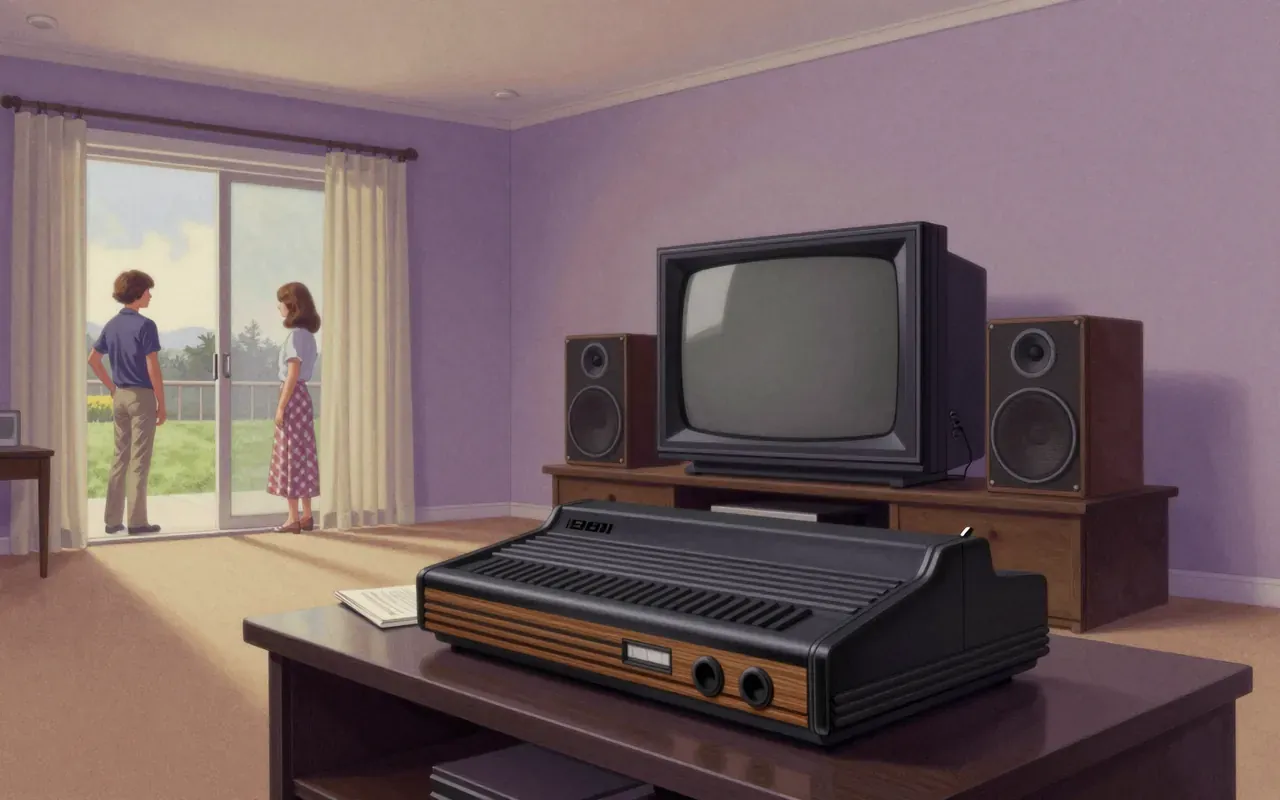
The Atari 2600 is a home video game console developed and produced by Atari, Inc. Released in September 1977 as the Atari Video Computer System (VCS), it popularized microprocessor-based hardware and games stored on swappable ROM cartridges — a format first used by the Fairchild Channel F in 1976. It was rebranded as the Atari 2600 in November 1982. Its development was enabled by the inexpensive MOS Technology 6507 microprocessor introduced in late 1975. It was prototyped under the codename 'Stella' by Atari subsidiary Cyan Engineering. Funding constraints led Atari’s CEO Nolan Bushnell to sell the company to Warner Communications in 1976 to complete the project. The console launched with two joysticks, a pair of paddle controllers, and the Combat cartridge. It was designed for low-cost mass production using a simplified architecture lacking a framebuffer, requiring programmers to 'race the beam' to generate graphics in sync with CRT television scanning.
It was built to kill arcade obsolescence — not to entertain.
2:33
How it got built
Its feasibility hinged on a $25 chip and a codename nobody outside Cyan Engineering used.
4:28
What shipped
Cartridges, joysticks, and paddles formed a complete input-output loop — no OS, no drivers, no abstraction.
5:51
When it got renamed
Rebranding in 1982 came after Warner bought Atari — not because the machine evolved, but because the market demanded hierarchy.
Worth your time?
Yes. Study the whole thing.
4/ 5
What works
Swappable ROM cartridges work reliably.
The joystick and paddle controllers deliver precise, low-latency input.
The Combat cartridge demonstrates real-time two-player interaction on minimal hardware.
What does not
It does not support smooth animation or complex sprites.
Its architecture forces trade-offs: no background graphics without sacrificing sprite count, no sound beyond two channels and one noise generator, no memory beyond 128 bytes of RAM.
Study it if
developers studying constraint-driven programming
historians of consumer electronics
engineers designing for cost-sensitive markets
Skip it if
users expecting plug-and-play compatibility
anyone needing multitasking or persistent storage
designers working with modern display standards
The written brief1 min read
What it is and the problem it solves
It is a home video game console that solves Atari’s problem of high arcade development costs and short lifespans. It replaces dedicated arcade hardware with a single, low-cost, programmable system.
How it works
It uses a MOS Technology 6507 microprocessor to run games from swappable ROM cartridges. It lacks a framebuffer. Programmers must time graphics output to match CRT television scanning — a technique called ‘racing the beam’.
What works
Swappable ROM cartridges work reliably. The joystick and paddle controllers deliver precise, low-latency input. The Combat cartridge demonstrates real-time two-player interaction on minimal hardware.
What does not
It does not support smooth animation or complex sprites. Its architecture forces trade-offs: no background graphics without sacrificing sprite count, no sound beyond two channels and one noise generator, no memory beyond 128 bytes of RAM.
What it changes
It shifts game development from fixed-purpose arcade boards to programmable home systems. It makes games replaceable commodities, not embedded hardware. It establishes the cartridge as the dominant distribution format for home consoles.
Is it worth your time
Yes — if you are studying how constrained hardware shapes software, or how mass-market electronics were engineered for cost over capability.